


A forged deed can be legally recorded in nearly any county office across the United States without the clerk ever verifying the signatures or the identity of the person filing it. This systemic gap allows criminals to transfer property ownership away from rightful owners with startling ease. You have spent years building your real estate portfolio. The idea of a stranger stealing your equity through a simple fraudulent filing is a valid source of anxiety. Understanding the mechanics of this threat is the first step toward protecting investment property from deed fraud and ensuring your financial legacy remains intact.
Title Fraud Defender recognizes that you value clarity and security over complex legal jargon. This 2026 guide provides a clear path to identifying the unique risks facing your assets. It explains why proactive monitoring is the only dependable way to secure your property equity. The following information covers how the recording process actually works, the limitations of recent legislative changes, and how professional oversight detects unauthorized activity immediately. Gain the knowledge and tools necessary to keep your investment portfolio shielded from unseen risks.
Key Takeaways
- Understand how criminals exploit the county recording system by filing forged deeds that clerks are legally required to accept without signature verification.
- Identify why non-owner occupied rentals and vacant land are specifically targeted by fraudsters who look for properties without a constant physical presence.
- Learn why proactive monitoring is the only dependable method for protecting investment property from deed fraud compared to unreliable manual checks.
- Distinguish between title insurance, which covers past ownership issues, and the continuous oversight provided by Title Fraud Defender for future threats.
- Discover how early detection through 24/7 monitoring prevents financial loss and allows you to resolve title issues before your home equity is compromised.
What is Deed Fraud and How Does it Threaten Your Equity?
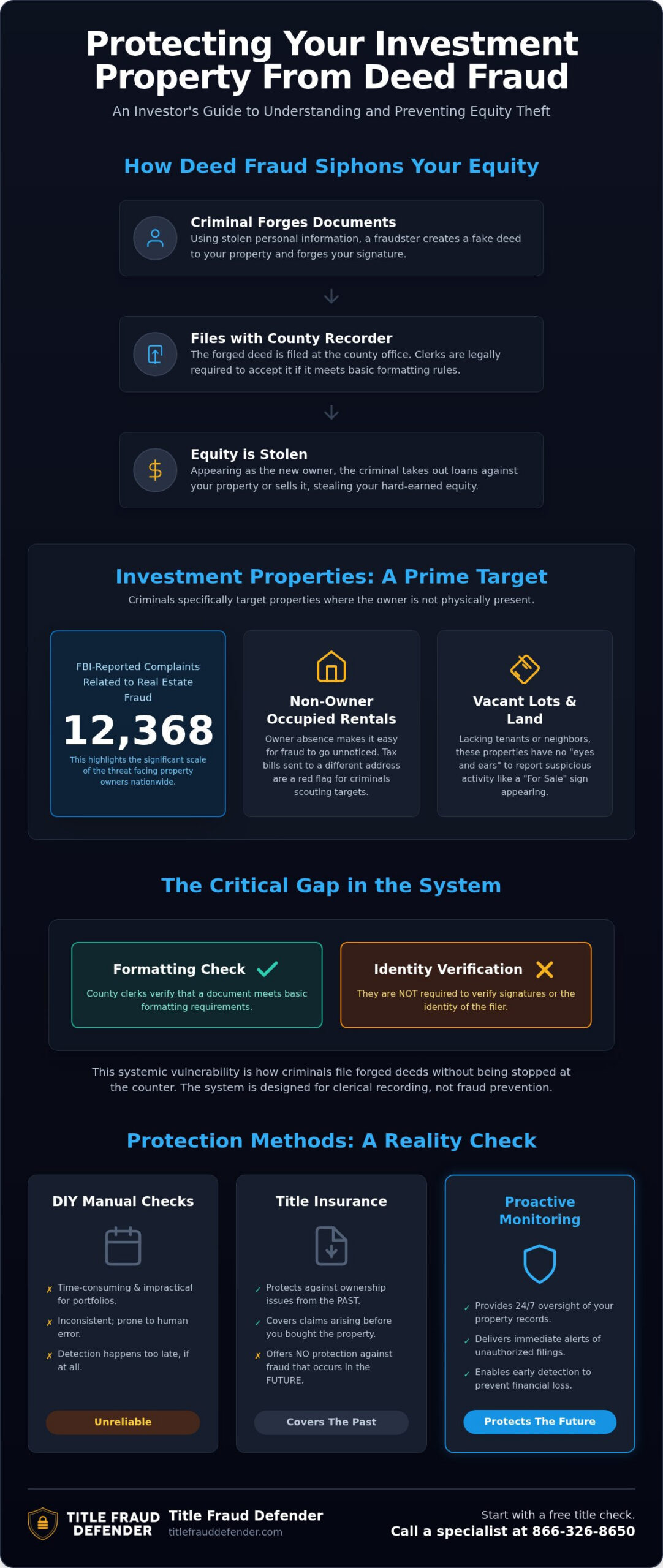
Deed fraud, often referred to as title theft, is the illegal transfer of property ownership through forged documents. The process is deceptively simple for a determined criminal. A fraudster forges your signature on a new deed and files it with the county recorder. Once that document is recorded, the criminal appears as the legal owner in public records. This act of fraudulent conveyance allows them to manipulate your asset for their own gain.
Protecting investment property from deed fraud is a unique challenge because the crime happens in the shadows. Once the deed is in their name, fraudsters can take out large loans against your hard-earned equity. They may even attempt to sell the property to an unsuspecting buyer. Most owners only discover the fraud months later. You might realize something is wrong when you receive a foreclosure notice for a loan you never signed or when you try to sell the property yourself. Recovering from this situation often requires thousands of dollars in legal fees and months of stressful litigation to clear your name. By then, your equity is gone and your title is clouded with legal issues.
Common Methods Used in Title Theft
Criminals use sophisticated tactics to bypass security measures. They often start with identity theft to gather the personal data needed to impersonate you. This information helps them create documents that appear authentic to county clerks who only check for basic formatting. Some fraudsters use fake notary seals to verify forged signatures. Others find compromised notaries who skip identity verification. These forged documents are then submitted to the county and recorded as legitimate ownership records.
The Difference Between Title Fraud and Identity Theft
Identity theft is a broad crime involving stolen data for credit or banking fraud. Title fraud is a specific attack on your physical property. Standard identity protection services do not monitor county records. They won’t alert you if a new deed or lien is filed against your investment. Title Fraud Defender provides the specialized oversight needed to bridge this gap. For senior homeowners, this dedicated sentry is essential for protecting investment property from deed fraud and securing your equity.
Vulnerabilities Specific to Investment and Rental Properties
Investment properties carry a significantly higher risk profile than primary residences. Criminals specifically hunt for properties where the owner is physically absent. If you own rental units or land in another state, you aren’t there to notice a “For Sale” sign on the lawn or a stranger changing the locks. This lack of physical presence is a major hurdle in protecting investment property from deed fraud. The FBI 2025 Internet Crime Report recorded 12,368 complaints related to real estate fraud, highlighting the scale of the threat. Fraudsters use public tax records to identify owners who receive tax bills at a different address. This mailing address discrepancy serves as a green light for criminals. It signals that the property is likely a rental or a second home, making it a prime target for a forged deed filing.
Real estate investors often prioritize yield and occupancy, but security must be part of that equation. A single fraudulent filing can wipe out years of cash flow and appreciation. Understanding why your specific assets are at risk is the only way to build a reliable defense. For those looking to extend this proactive approach to their family’s safety, The Wellbeing App offers comprehensive, round-the-clock security and monitoring.
Vacant land is vulnerable because it lacks the “eyes and ears” of tenants or neighbors who might report suspicious activity. A criminal can pose as the owner and “sell” the lot before you realize the title has changed. In rental scenarios, you are often disconnected from daily mail delivery at the property site. Criminals exploit this gap. They know they can file a fraudulent document and you won’t find out until tax season or when you attempt to refinance. These properties are often unencumbered, making them attractive for quick equity theft.
Managing Risks for Real Estate Portfolios
Managing multiple properties increases oversight complexity. Manually checking county records for a large portfolio is not sustainable or reliable. Human error is inevitable with DIY checks, and the time required is better spent managing your business. Title Fraud Defender provides Bulk Property Protection to streamline this for investors. This service acts as a digital sentry, ensuring every asset is monitored 24/7. It removes technical barriers and provides immediate alerts for any unauthorized activity.
You deserve to know that your equity is secure across every zip code where you own property. This peace of mind allows you to focus on growth rather than constant worry. You can explore the various protection levels to find the right fit for your specific portfolio size and risk tolerance.
Why County Recording Systems Cannot Stop Fraudulent Filings
Many property owners assume that the county recorder’s office acts as a gatekeeper. They believe that a clerk verifies the signatures on every deed before it becomes part of the public record. Unfortunately, this is not how the system functions. County recording offices are ministerial in nature. This means they are legally required to record any document that meets basic formatting requirements, such as margins, legibility, and the presence of a notary seal. They do not investigate the truth of the claims within the document.
Clerks generally do not have the legal authority or the technical tools to verify if a signature on a deed is authentic. If the paperwork looks correct on the surface, it is accepted and filed. The burden of verifying the validity of a property transfer falls entirely on the parties involved, not the government agency. This systemic gap allows forged deeds to enter the public record with ease. Once a fraudulent document is accepted, it creates an immediate cloud on your title that can take months or years of legal action to resolve.
The Role of the County Recorder
The primary job of the recorder is to maintain a public archive of transactions. They are not tasked with policing those transactions for fraud. Once a deed is recorded, the law grants it a “presumption of validity.” It is considered a legal fact until a court of law proves otherwise. Criminals exploit this rule to their advantage. They use the time between the fraudulent filing and your eventual discovery to quickly liquidate equity or secure high-interest loans against your property. Protecting investment property from deed fraud requires understanding that the government will not stop a forged filing on your behalf.
Why DIY Manual Checks are Often Too Late
Some investors attempt to protect their assets by manually checking county websites. If you only check the records once a quarter or even once a month, you are leaving a massive window of opportunity for fraudsters. A criminal only needs a few days to cause significant financial harm once they have a recorded deed in hand. Continuous monitoring acts as a digital sentry, alerting you the moment a change is detected. Title Fraud Defender provides the early warning necessary to stop financial damage before it escalates. For senior homeowners, this proactive approach is the most effective method for protecting investment property from deed fraud and ensuring your equity remains secure.
Evaluating Your Defense: Monitoring, Insurance, and Manual Checks
Securing your real estate assets requires a clear understanding of the tools at your disposal. Many investors believe they are already protected by standard safeguards like title insurance or periodic manual record searches. However, these traditional methods often fail when faced with modern title theft. Protecting investment property from deed fraud requires a shift from reactive recovery to proactive detection. Early detection is the only way to prevent the loss of your home equity and avoid the long, expensive legal battles required to reclaim a stolen title. You need a defense that works in real time to match the speed of today’s criminals.
The Limits of Title Insurance
Title insurance is a one-time purchase made during the closing process. It’s designed to protect you from problems that existed before you purchased the property, such as unknown liens or historical ownership disputes. It’s a backward-looking product. Owner’s title insurance typically doesn’t provide coverage for a forged deed filed years after the policy was issued. While insurance might help you resolve a claim after the fact, it doesn’t alert you that a crime is currently in progress. Monitoring fills this critical gap by providing real-time awareness of new threats to your equity.
Why Proactive Detection is the Only Dependable Protection
Speed is the most important factor in stopping a fraudster. Once a deed is recorded, a criminal can quickly list the property for sale or drain the equity through new loans. Manual checks of county records are unreliable because they leave large windows of time where your property is completely unprotected. If you only check records once every few months, the damage is already done. Professional monitoring provides 24/7 oversight of the public record for any new filings or liens. It acts as a digital sentry that never blinks.
Proactive detection allows you to contact local authorities and legal counsel before a fraudster can finalize a sale or disappear with loan proceeds. Title Fraud Defender provides Expert Guidance to help you navigate the necessary steps immediately after an alert is triggered. This level of oversight is essential for protecting investment property from deed fraud in an era where property records are increasingly accessible to bad actors.
Securing Your Portfolio with Title Fraud Defender
Title Fraud Defender provides a comprehensive suite of services built specifically for the needs of property owners and real estate investors. While the county recording system remains vulnerable to forged filings, you can take control of your asset’s safety. The core of this defense is 24/7 Title Monitoring. This service ensures you are the first to know if any unauthorized changes are made to your deed. By acting as a digital sentry, it bridges the gap between the filing of a fraudulent document and your awareness of it. This rapid notification is essential for protecting investment property from deed fraud before a criminal can exploit your equity.
In addition to monitoring, you receive detailed Lien Reports. These reports are essential for identifying hidden encumbrances or unauthorized debt that could quietly erode your equity. For senior homeowners who are often targeted by predatory schemes, Title Fraud Defender offers specialized support to navigate these specific risks. Protecting investment property from deed fraud is not just about having an alert system. It is about having a dedicated partner that understands the high stakes of real estate ownership and the emotional toll of title disputes.
The Benefits of Continuous Title Monitoring
Continuous oversight provides instant alerts the moment a change is detected in the public record. You no longer have to worry about what might be happening at a rental property or a vacant lot located hundreds of miles away. This constant vigilance gives you the peace of mind to focus on your investment strategy rather than administrative anxiety. Title Fraud Defender has streamlined the entire process to make it effortless for the user. It removes the technical barriers that often make property security feel overwhelming or inaccessible for non-technical owners.
Take the First Step Toward Security
Securing your financial legacy starts with accurate information. You can begin with a free title check to verify your current ownership status and confirm that no unexpected filings exist. This initial check provides a baseline of security for your assets. If you manage a complex portfolio or have specific concerns about a high-value asset, call a specialist at 866-326-8650 for personalized guidance. Protecting investment property from deed fraud is a manageable process when you have the right tools and expert support. Empower yourself today by moving from a state of uncertainty to one of total oversight.
Secure Your Real Estate Legacy
The vulnerability of the U.S. recording system is a reality that every real estate investor must face. Because county clerks are legally required to record documents that appear valid on the surface, forged deeds often slip into the public record undetected. This systemic gap places the burden of vigilance entirely on your shoulders. Protecting investment property from deed fraud requires a shift from manual, infrequent checks to a state of constant, automated oversight.
Title Fraud Defender provides the essential tools to maintain this vigilance through 24/7 Professional Title Monitoring and Specialized Bulk Property Protection for Investors. You don’t have to navigate these risks alone. Expert Guidance from property security specialists is always available to help you respond to threats before they escalate into costly legal disasters. Early detection turns a potential catastrophe into a manageable incident. Take a decisive step today to ensure your hard-earned equity remains exactly where it belongs.
Call 866-326-8650 to speak with a specialist and gain the peace of mind that comes from knowing your portfolio is under professional protection. You have worked hard to build your equity, and you deserve the confidence that it is shielded by a digital sentry that never blinks.
Frequently Asked Questions
Can title insurance protect me from future deed fraud?
No, title insurance typically only covers issues that existed before you purchased the policy. It is a one-time protection for historical title defects. It won’t alert you to a forged deed filed next week or next year. For protecting investment property from deed fraud occurring in the future, you need active monitoring. Title Fraud Defender fills this gap by watching the public record for new filings that occur long after your closing date.
How often should I check my property records for unauthorized changes?
You should ideally have your records monitored 24/7 because manual checks are often too late. If you only check the county records once a quarter or even once a month, a criminal has a massive window to sell your property or drain its equity. Relying on DIY checks is risky for busy investors. Title Fraud Defender automates this process, acting as a digital sentry so you don’t have to spend your time navigating confusing county websites.
What should I do if I receive an alert that my title has changed?
You should immediately contact local law enforcement and a real estate attorney to report the unauthorized filing. Fast action is critical to stop the fraudster from liquidating your equity. Title Fraud Defender provides Expert Guidance to help you understand the specific steps needed for resolution. They help you navigate the process of clearing your title, which can be an emotionally taxing and complex journey without a knowledgeable partner by your side.
Is deed fraud common for rental properties and vacant land?
These properties are prime targets because the owner is not physically present to notice suspicious activity. Criminals look for mailing addresses that differ from the property address, which signals a rental or second home. Vacant land is especially vulnerable as there are no tenants or neighbors to raise an alarm. Protecting investment property from deed fraud is essential for these high-risk assets. Professional monitoring ensures you are alerted the moment a change is detected.
Why doesn’t the county recorder verify the signatures on a deed?
The county recorder’s office has a ministerial duty, meaning they are legally required to record any document that meets basic formatting requirements. Clerks don’t have the legal authority or the tools to verify if a signature is authentic or if a notary seal is legitimate. They are archivists, not investigators. This systemic gap allows forged documents to enter the public record easily. It is your responsibility to monitor your title for any unauthorized changes.
How does Title Fraud Defender monitor my property 24/7?
Title Fraud Defender uses specialized technology to provide constant oversight of the public record for your property. This system scans for new deeds, liens, or encumbrances filed against your title. The moment a change is detected, you receive an instant alert. This removes the technical barriers to property security and ensures you are the first to know about unauthorized activity. It is a streamlined process designed to protect your financial integrity without requiring your constant attention.
Can a criminal really take out a mortgage on my house without me knowing?
Yes, once a criminal has recorded a forged deed in their name, they can apply for loans or mortgages using your property as collateral. While legitimate platforms like Personal Loans connect honest borrowers with lenders, fraudsters exploit stolen identities to secure unauthorized financing against your home. They often target high-equity properties to maximize their gain. Because lenders rely on the presumption of validity in the public record, they may issue these loans before you even realize your title has been compromised. This is why early detection is the only dependable way to secure your property equity.
A lien report is a detailed document that identifies any legal claims or encumbrances filed against your property. For investors, this is a vital tool to ensure that no unauthorized debt has been attached to your asset. Hidden liens can complicate sales, refinances, and threaten your equity. Title Fraud Defender provides these comprehensive reports so you have a clear understanding of your property’s financial status and can address any issues before they escalate.