


Imagine the sudden, sharp realization that the home you have spent decades paying for is no longer legally yours in the eyes of the county. You feel a deep sense of vulnerability when you discover a forged signature has stripped away your equity. It’s a high-stakes crisis that demands immediate, decisive action. Knowing what to do if you are a victim of title fraud is essential to stopping the damage before it becomes permanent. You likely feel overwhelmed by legal jargon and the weight of a process that seems designed to be slow. Title Fraud Defender understands this fear and provides the clear path you need to regain your footing.
You can reclaim your property rights and secure your home equity by following this authoritative guide. It provides a clear, linear roadmap to stop fraudulent activity and restore your legal ownership. This article previews the vital steps required to halt theft, from filing specific reports to implementing professional oversight. You will learn how to move from a state of anxiety to a position of absolute security. Title Fraud Defender simplifies the recovery journey so you can focus on restoring your peace of mind while a proactive guardian monitors your property for any further threats.
Key Takeaways
- Act within the first 24 hours to secure financial accounts and freeze your credit. Speed is the most effective tool for minimizing further financial exposure.
- Follow a specific sequence of steps for what to do if you are a victim of title fraud to build a legal paper trail. This includes filing formal reports with both local and federal authorities.
- Identify the differences between forged deeds and fraudulent transfers to prepare for the civil legal process. Reclaiming a title often requires specific legal actions that go beyond a police report.
- Understand that county recording offices are not legally authorized to verify the authenticity of deeds. This systemic gap makes professional monitoring an essential shield for your property.
- Transition to a proactive defensive posture with 24/7 title monitoring. Title Fraud Defender provides the constant vigilance needed to detect unauthorized changes in real time.
Immediate Steps to Take After Discovering Title Fraud
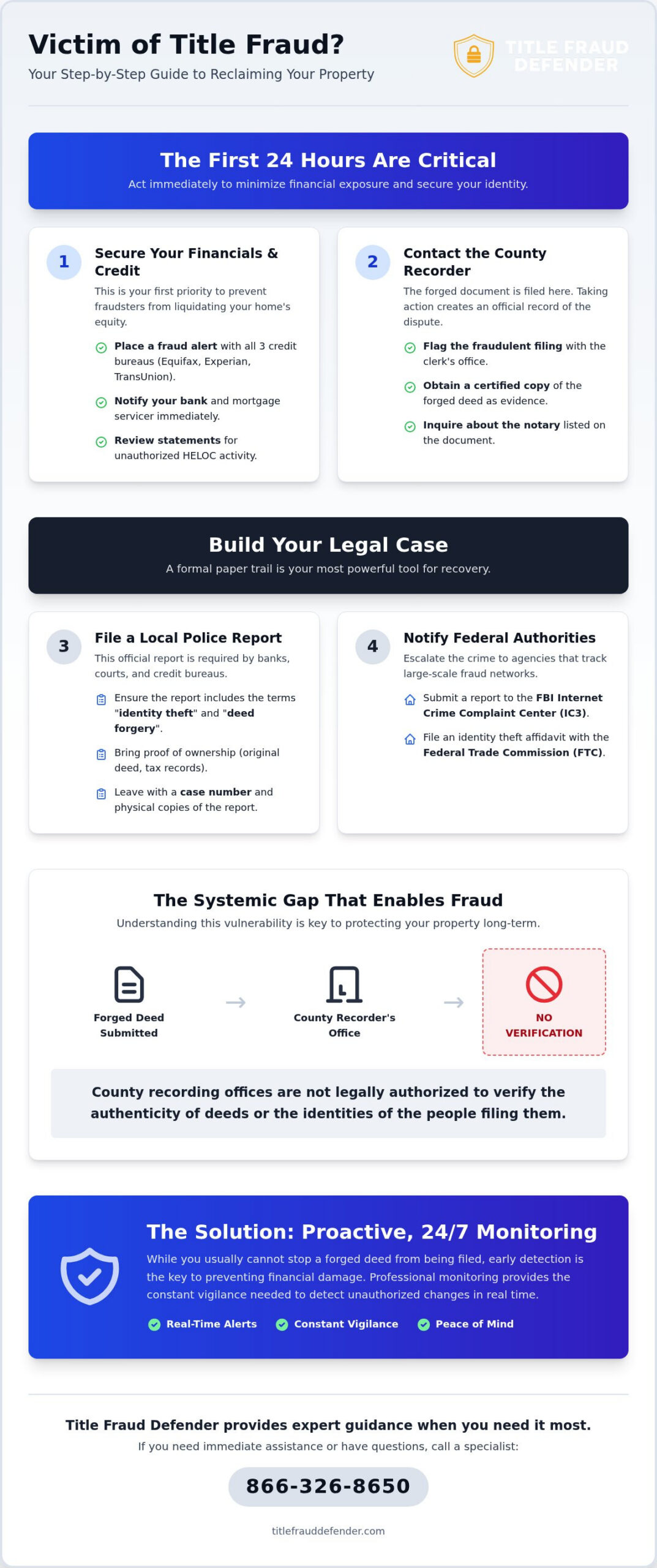
Discovery is the first step in a high-stakes race. You must act within the first 24 hours to minimize your financial exposure. Title fraud isn’t just about a stolen name; it’s about the equity you’ve built over decades. If you are wondering what to do if you are a victim of title fraud, your priority is to freeze the fraudster’s ability to liquidate your home’s value. Secure your identity first, then focus on the property record. Prompt action creates a barrier between your hard-earned assets and the criminal’s exit strategy.
Securing Your Financial Accounts and Credit
Start by placing a fraud alert on your credit reports. Contact the three major bureaus (Equifax, Experian, and TransUnion) immediately. This prevents criminals from opening new lines of credit in your name using your home as collateral. Understanding Mortgage Fraud can help you see how identity theft often leads to these unauthorized property transfers. Criminals frequently use stolen identities to secure loans against properties they don’t own.
Next, notify your bank and mortgage servicer. Tell them your title has been compromised. Ask them to review recent statements for any unauthorized home equity line of credit (HELOC) activity. If a criminal has already withdrawn funds, you need a formal record of your report to protect yourself from liability. Clear communication with your lender ensures they are on high alert for any unusual payout requests or account changes.
Contacting the County Recorder of Deeds
The county recorder’s office is where the forged document lives. Visit them or call to flag the fraudulent filing immediately. While they cannot simply delete the deed without a court order, they can provide you with a certified copy of the document. This copy is your primary piece of evidence for law enforcement and legal proceedings. It contains the signatures and timestamps necessary to prove the theft occurred.
Ask the clerk if the county offers a property alert or notification program. Many jurisdictions now provide these services, though they are often reactive rather than proactive. You should also inquire about the specific notary public who acknowledged the forged signature. This information is vital for investigators trying to track the source of the forgery and the individuals involved in the fraudulent act, and working with experienced private investigation firms such as iigpi.com can help gather the evidence needed for legal action.
Recovery is a heavy burden, but you don’t have to carry it alone. For senior homeowners, the emotional toll can be just as significant as the financial loss. Title Fraud Defender suggests initiating a professional title check to identify every unauthorized change made to your property’s history. This ensures no hidden liens remain. If you need immediate assistance, call a specialist at 866-326-8650 for expert guidance on your next steps.
Reporting the Crime to Federal and Local Authorities
Establishing a comprehensive paper trail is your best defense. When you’re determining what to do if you are a victim of title fraud, you must create a formal record that proves the crime occurred. This trail serves as your primary weapon when dealing with lenders, courts, and credit bureaus. It transforms your claim from a verbal complaint into a legal reality. Without these documents, you lack the standing required to dispute fraudulent loans or correct public records.
Filing a Local Police Report
Start at the local level. Visit your local police station to file a formal report. Bring physical evidence of your rightful ownership, such as your original deed or property tax records. You must ensure the officer includes the specific terms “identity theft” and “deed forgery” in the report. These phrases are critical for triggering protections under state and federal law. They signal to other institutions that this is a criminal matter rather than a simple clerical error.
Don’t leave the station without a case number. Request multiple physical copies of the final report. You’ll need these for your bank, the county recorder, and potential legal counsel. For senior homeowners, having these documents organized in a single folder can reduce the stress of repeating your story to multiple officials. This physical file becomes the foundation of your recovery effort.
Notifying the FBI and Federal Trade Commission
Local police may have limited resources for digital crimes, so you must escalate the matter. Submit a report to the FBI Internet Crime Complaint Center (IC3). This agency tracks large-scale real estate fraud patterns and can link your case to broader criminal networks. You should also Report Fraud to Federal Agencies by filing an identity theft affidavit with the Federal Trade Commission (FTC). This affidavit is a sworn statement that helps you clear your name with creditors.
These federal reports are powerful tools. They provide a standardized way to dispute fraudulent loans and can be used to strengthen your case in civil court. Keep a meticulous log of all interactions. Record every agency case number, the date of the report, and the names of the officers or agents you spoke with. This level of detail shows authorities that you are a diligent victim who is serious about reclaiming your property.
While reporting is a necessary part of the recovery process, it is often reactive. Taking control of your property’s future requires constant vigilance to ensure no new fraudulent documents are filed. You can explore protective monitoring options to ensure you are alerted the moment a document is filed, rather than months after the damage is done. Title Fraud Defender provides the oversight needed to catch these issues before they escalate into legal battles.
Navigating the Legal Path to Reclaiming Your Property Title
Reclaiming your home isn’t as simple as showing a police report to the county clerk. While the criminal case punishes the thief, a civil lawsuit is usually required to fix the public record. When you are deciding what to do if you are a victim of title fraud, remember that the criminal justice system and the civil property system move on different tracks. Understanding What is Home Title Theft is the first step in realizing that the burden of proof rests on you. You must distinguish between a forged deed, which is signed by a criminal pretending to be you, and a fraudulent transfer, which might involve someone tricking you into signing a document.
Consulting a Specialized Real Estate Attorney
Working with Your Mortgage Lender
If a criminal has taken out a loan against your home, your mortgage servicer might begin foreclosure proceedings if that loan isn’t paid. You must contact the fraud department of your mortgage servicer immediately. Explain what to do if you are a victim of title fraud by providing them with the local and federal reports you gathered earlier. Request a temporary stay on any payments or actions related to the fraudulent liens. Provide the lender with the following items to support your claim:
- Certified copies of your local police report.
- Your signed FTC identity theft affidavit.
- The confirmation receipt from your FBI IC3 complaint.
For senior homeowners, the legal process can feel particularly draining. It’s a methodical climb toward restoration. Title Fraud Defender emphasizes that while you handle the legal battle, expert guidance can help you manage the technical hurdles. If you feel lost in the jargon, call 866-326-8650 to speak with a specialist. They can help you understand the documents you need to present to your attorney. Maintaining a proactive stance through continuous monitoring is the only way to ensure your equity remains yours throughout this recovery process.
Understanding Why County Offices Cannot Prevent Deed Forgery
The U.S. property recording system is built on trust and public accessibility. While this makes buying and selling homes easier, it also creates a significant systemic vulnerability. County recorder offices are generally required to record any document that meets basic legal requirements for formatting and notarization. They do not have the legal authority to verify the identities of the parties involved. Knowing what to do if you are a victim of title fraud starts with understanding why the system failed to stop the crime in the first place.
The Lack of Verification in Public Records
Recording offices accept documents that appear valid on their face. If a deed has a signature and a notary seal, the clerk’s job is simply to file it into the public record. Criminals exploit this by using fraudulent notaries or forged seals to bypass standard security checks. Because these records are open to the public, scammers can easily find your property information and draft a convincing forgery. The system is designed for speed and transparency, not for the deep identity verification required to stop a determined thief.
Why DIY Manual Monitoring Is Insufficient
Many homeowners believe they can protect themselves by checking county websites every few months. This manual approach is often too late. There is frequently a significant delay between the moment a deed is filed and when it appears in a searchable online database. By the time you see the change, a criminal may have already secured a loan against your equity. You are essentially looking at a snapshot of the past rather than a live feed of your property’s status.
Manual checks also risk missing “clouds” on the title. These are hidden liens or secondary documents that don’t always appear in a basic name search. For senior homeowners, the stakes are too high to rely on a process that only looks backward. Professional monitoring provides the speed and automated alerts necessary to catch a filing before the financial damage becomes irreversible. Contrast this with manual checks that might only happen once or twice a year, leaving long windows of vulnerability. Understanding the myths and realities of a property records monitoring service can help you make an informed decision about the level of protection your home truly needs.
A forged deed is legally filed before you are ever notified by the county. In most jurisdictions, the government is not required to mail you a notification when your title changes hands. This means the first time you hear about the fraud might be when a foreclosure notice arrives or a utility bill comes in a different name. Early detection through a proactive digital sentry is the only way to close the gap between a fraudulent filing and your response. If you are already concerned about unauthorized activity, knowing what to do if you are a victim of title fraud involves moving from a reactive mindset to one of constant vigilance.
Implementing 24/7 Monitoring to Prevent Future Fraud
You cannot change the way county offices record documents, but you can change how you oversee your property’s legal status. Shifting from a reactive mindset to a proactive defensive posture is the only way to secure your financial future. If you have been searching for what to do if you are a victim of title fraud, the most important step is ensuring that a single incident does not lead to a lifetime of financial loss. Continuous monitoring acts as an essential shield. It detects unauthorized changes in real time, allowing you to stop a fraudster before they can liquidate your hard-earned equity.
How Title Fraud Defender Protects Your Equity
Title Fraud Defender provides 24/7 continuous monitoring for your property title and lien status. Most homeowners do not realize that a forged deed can sit in public records for months or even years before it is discovered. By then, the damage is often done. This service eliminates that window of vulnerability by providing instant alerts the moment any document is recorded against your property. You receive a notification as soon as a change occurs, not months later when a bill arrives or a lender calls.
You do not have to interpret complex legal filings or technical jargon on your own. Expert guidance is a core component of the service. If an alert is triggered, you have access to specialists who can help you understand the gravity of the situation and provide a clear path to resolution. This level of oversight is designed for speed and simplicity. It mirrors the ease of use that modern homeowners expect while maintaining the rigorous standards of a professional security service. It ensures that you are never left alone to manage a potential crisis.
Specialized Protection for Senior Homeowners
senior homeowners are frequently targeted by title thieves because they often hold the most significant equity in their properties. Many have spent decades paying off a mortgage, which makes the home a prime target for fraudulent lien activity. Individuals over 60 accounted for 44 percent of all financial losses in real estate fraud in 2024, making property title protection for seniors an urgent priority that goes far beyond basic awareness. Monitoring provides a digital sentry that stands guard over your most valuable asset. This proactive stance ensures that no time is wasted when your property rights are at stake. It follows a logical progression that makes the complicated process of title oversight feel effortless.
Protecting your legacy should not be a part-time job or a source of constant anxiety. You can take the first step toward total security by choosing to verify property ownership status with a free initial title check. This establishes a clean baseline for your recovery and future protection. If you have questions about what to do if you are a victim of title fraud, call 866-326-8650 to speak with a specialist. They can help you implement a plan that keeps your equity secure and your property rights intact.
Taking Decisive Action for Your Property’s Security
Recovery is a race against time. You have learned that speed and a meticulous paper trail are your most effective weapons when reclaiming your property rights. Knowing exactly what to do if you are a victim of title fraud empowers you to stop a criminal’s progress before they can vanish with your home equity. While county systems remain vulnerable to forged filings, your financial security is manageable through early detection and expert guidance. You don’t have to carry this burden alone.
Title Fraud Defender stands as a proactive digital sentry for your home. By implementing 24/7 professional title monitoring and utilizing comprehensive property lien reports, you close the gap that criminals exploit. Many homeowners mistakenly believe that title insurance alone is sufficient protection, but learning the truth about what a property records monitoring service actually provides can reveal critical gaps in your current defense strategy. You gain the peace of mind that comes from constant oversight and the clarity of having a knowledgeable partner by your side. Expert guidance ensures that every alert is handled with precision and speed.
Secure your property and view protection plans today
Your home is more than an asset; it is your legacy. With the right tools and a vigilant approach, you can protect that legacy from unseen threats. Stay proactive and rest easy knowing your equity is shielded by professional oversight.
Frequently Asked Questions
Is it possible to stop a forged deed from being filed at the county office?
No, it is generally not possible to stop a forged deed from being filed because county recorder offices are legally required to accept any document that meets basic formatting and notarization standards. They do not verify signatures or identities at the time of filing. This systemic gap is why proactive monitoring is so critical. Early detection allows you to respond before a criminal can use that forged deed to secure loans against your home.
How long does it typically take to reclaim a stolen property title?
Reclaiming a stolen property title typically takes several months to several years, depending on the complexity of the fraud and the court’s schedule. Because this involves a civil lawsuit, you must follow specific legal procedures to prove the forgery and remove the fraudulent filing. Acting quickly when you first learn what to do if you are a victim of title fraud can help expedite the initial reporting and evidence gathering phases.
Will my homeowners insurance cover the costs of title fraud recovery?
Standard homeowners insurance policies generally don’t cover the costs associated with title fraud recovery. These policies are designed to protect against physical damage to the structure or liability for injuries on the property. You would need a specific owner’s title insurance policy, which is usually purchased at the time of closing, to potentially cover legal fees or financial losses resulting from a forged deed or unauthorized transfer.
What is a quiet title action and when is it necessary?
A quiet title action is a civil lawsuit filed to “quiet” any challenges or claims to your property ownership. It’s necessary when a forged deed or unauthorized lien has been recorded against your title. This legal process results in a court order that declares you the sole rightful owner and clears the public record of any fraudulent documents. It is the primary way to restore your legal property rights after a theft.
Can someone take out a mortgage on my house without me knowing?
Yes, a criminal can take out a mortgage or a home equity line of credit on your house without your knowledge by using a forged deed. Once they record a document making them the owner in public records, they can apply for loans using your home as collateral. This is why 24/7 monitoring is essential. It alerts you the moment a new document is filed, helping you stop the criminal’s strategy.
What are the most common red flags that my title has been compromised?
Common red flags include missing property tax bills, receiving utility bills in someone else’s name, or getting mail addressed to a stranger at your property. You might also receive unexpected loan documents or foreclosure notices for a mortgage you never signed. If you notice these signs, you must immediately investigate what to do if you are a victim of title fraud to protect your remaining home equity and legal rights.
How much does a professional title monitoring service cost?
The cost of professional title monitoring varies based on the level of oversight and the number of properties protected. Title Fraud Defender offers different plans designed to provide continuous vigilance and expert guidance. While specific costs aren’t listed here, professional monitoring is a strategic investment compared to the high legal fees required to resolve a title theft incident. You can view current protection plans and features on the company website.
Does Title Fraud Defender provide legal representation for victims?
Title Fraud Defender doesn’t provide legal representation or act as your attorney in court. Instead, the service focuses on 24/7 continuous monitoring and expert guidance to help you navigate the recovery process. Specialists provide the information and reports you need to work effectively with law enforcement and your own real estate attorney. This proactive oversight helps you detect fraud before it requires an extensive and costly legal battle.