

Article by
George McCleary
CEO, Title Fraud Defender
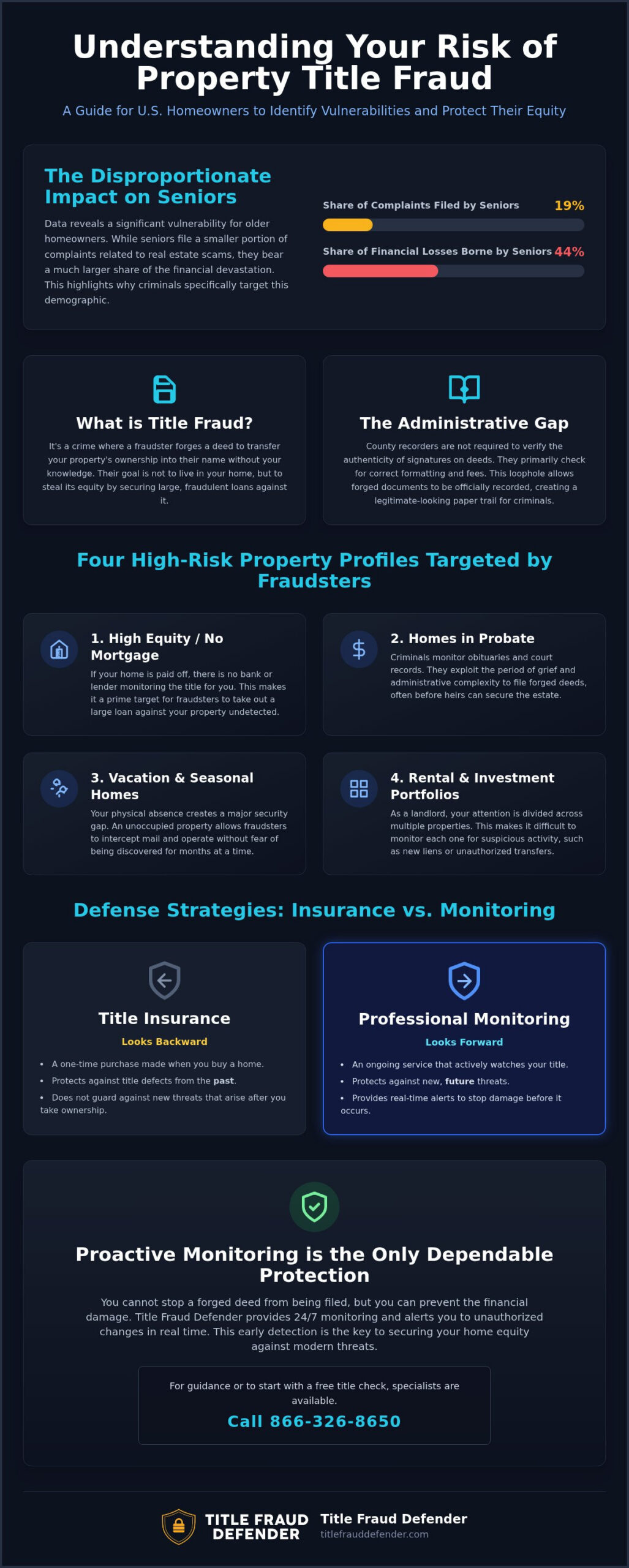
Did you know that while seniors file only 19 percent of official complaints, they account for 44 percent of the financial losses associated with real estate scams? This striking imbalance reveals a harsh truth about who is most at risk for title fraud in the United States. You have worked hard to build equity in your home. The thought of a stranger claiming ownership through a forged document is deeply unsettling. It is a quiet crime that often goes unnoticed until the damage is done because most county systems do not verify the validity of the deeds they record.
Title Fraud Defender understands the anxiety that comes with these unseen risks. You deserve to know exactly where your vulnerabilities lie without being subjected to alarmist marketing. This article identifies the specific property types and homeowner profiles that criminals target most frequently. You will gain a clear understanding of the mechanics of deed fraud and the critical difference between title insurance and active monitoring. This guide provides a reliable method to detect unauthorized changes early and a clear path to securing your home equity against modern threats.
Key Takeaways
- Learn how criminals use forged deeds to transfer property ownership without your knowledge or consent.
- Identify specific property profiles to understand who is most at risk for title fraud, especially those with high equity or vacant status.
- Understand the administrative gaps in county recording systems that allow fraudsters to file unauthorized documents without immediate verification.
- Recognize early warning signs such as missing property tax assessments or unexpected correspondence regarding loans you never requested.
- Discover how Title Fraud Defender provides proactive 24/7 monitoring to detect unauthorized changes before financial damage occurs.
Understanding Property Title Fraud and Your Vulnerability
Property title fraud is a deceptive crime that strikes at the heart of your financial security. Understanding who is most at risk for title fraud is the first step in building a proper defense for your home. This crime occurs when a criminal files a forged deed to transfer ownership of your property into their name without your knowledge. This is essentially a sophisticated form of identity theft. The primary goal is rarely to move into the home. Instead, fraudsters look to strip your home equity or secure large, fraudulent loans using your property as collateral.
Many homeowners feel a false sense of security because they believe the local government protects their title. You might assume that a clerk verifies every signature on a filed deed. However, Title Fraud Defender notes that county recorders generally only ensure a document meets basic filing requirements. They check for the correct fee, legible text, and proper formatting. They do not verify authenticity. This administrative gap is why agencies like the New York City Sheriff’s Office must dedicate significant resources to investigating real property larceny and deed fraud after the document has already been recorded.
The Distinction Between Title Insurance and Monitoring
It’s vital to understand that title insurance and title monitoring serve entirely different purposes. Title insurance is a one-time purchase made when you buy your home. It protects you against defects that happened in the past, such as an undiscovered lien from a previous owner or a mistake in a historical record. It does not watch for new threats that emerge years after you move in.
Professional monitoring is a proactive service. It acts as a digital sentry for your home equity by providing constant oversight. While insurance looks backward, Title Fraud Defender looks forward. Monitoring alerts you to new, unauthorized changes in real time. This allows you to act immediately, which is the only way to prevent the total loss of your equity once a forged document enters the system.
Why Seniors Are Frequently Targeted
When assessing who is most at risk for title fraud, data consistently points toward older homeowners. If you are aged 55 or older, you likely have significant equity built up over decades of mortgage payments. This makes your property a high-value target for those looking to secure illicit loans. Criminals often assume that seniors are less likely to monitor digital property records or check their credit reports every month. They look for quiet equity that they can exploit without immediate detection. You can find more information on these specific threats by visiting the Title Fraud Defender senior homeowners page. Protecting your legacy requires active oversight rather than passive trust.
The Four Most Common High-Risk Property Profiles
Criminals do not choose targets at random. They look for the path of least resistance. When identifying who is most at risk for title fraud, several specific property profiles stand out as high-value targets. Understanding these vulnerabilities allows you to take defensive action before your equity is compromised. Most fraudsters look for properties where their actions will go undetected for the longest possible time.
Properties with high equity and no mortgage are primary targets. If you have paid off your home, you have achieved a major financial milestone. Unfortunately, this also means there is no bank or lender monitoring the title for new activity. Fraudsters can easily record a forged deed and then take out a large loan against the property. Since there is no existing mortgage, the new fraudulent loan appears legitimate to many lenders. The criminal walks away with the cash, leaving you to deal with a lien you never authorized.
Homes involved in probate or belonging to deceased individuals are also at extreme risk. Identity thieves scan public obituaries and court records to find properties in transition. They know that family members may be distracted by grief or administrative legal processes. This creates a window where a forged transfer can go unnoticed for months. By the time the estate is settled, the property may have already been sold or heavily leveraged by a criminal posing as an heir.
Understanding who is most at risk for title fraud is essential for any property owner with significant equity or multiple holdings. You can review protection plans from Title Fraud Defender to see how 24/7 monitoring can shield these specific vulnerabilities.
Vacation Homes and Seasonal Properties
Landlords face unique challenges because they do not live on-site. When attention is divided across multiple units, it is difficult to witness suspicious activity. Fraudulent liens can be placed on rental properties to siphon off equity. Real estate investors should consider bulk property protection to secure their entire portfolio. Proactive defense is the only way to ensure your equity remains yours.
How Property Title Fraud Happens Without Your Knowledge
Title fraud is not a crime of brute force. It is a crime of paperwork and administrative exploitation. A fraudster begins by obtaining the precise legal description of your property through public records. This information is readily available and requires no special authorization to access. Once they have these details, the criminal creates a forged deed. This document is designed to look identical to a legitimate transfer of ownership from you to them or an alias they control.
The next step involves a deceptive layer of officialdom. The fraudster must have the forged deed notarized. They often achieve this by using a fake identification card or a compromised notary seal. In some cases, they may even bribe a corrupt notary. This step is crucial because it gives the forged document the appearance of legal weight. When the criminal submits the deed to the county recorder, the administrative staff adds it to the official property history. They do not call you to verify the sale. They simply record the document and move to the next file.
This silent process is why understanding who is most at risk for title fraud is so critical. If you are not actively looking for these changes, they can remain hidden for years. Criminals rely on this lack of oversight to complete their theft without any immediate confrontation. You cannot rely on the recording office to protect your interests because their role is strictly clerical.
The Vulnerability of County Recording Systems
You might expect the government to act as a gatekeeper for your property rights. In reality, county clerks are administrative officials rather than forensic document examiners. Their primary duty is to ensure that documents meet the standard filing requirements for the jurisdiction. The system operates on an inherent assumption of validity. If the document has the correct signatures and a notary stamp, it is typically accepted. Once a forged deed is recorded, the legal burden of proof shifts entirely to you. You must prove the forgery to regain clear ownership, which is a stressful and expensive process.
Consequences of Undetected Fraud
The damage caused by undetected fraud is immediate and severe. Once a fraudster has a recorded deed in their name, they can use your property as collateral. They often apply for home equity lines of credit (HELOCs) and disappear with the funds. Alternatively, they may sell the home to an unsuspecting third party. This creates a “cloud on title,” a legal term meaning the ownership history is no longer clear. Resolving these issues often requires months of legal intervention and significant financial resources. Without early detection, your home equity can be stripped away before you even realize a crime has occurred.
Red Flags and Risk Factors for Modern Homeowners
Detecting fraud early is the only way to prevent severe financial damage. While many property crimes are loud and obvious, title fraud is a quiet administrative theft. You must stay vigilant for subtle changes in your daily routine. Missing utility bills or property tax assessments are primary indicators that someone has redirected your mail. Criminals do this to ensure that official notices of ownership changes or new liens never reach your front door.
Always investigate unexplained communications regarding your property. If you receive a letter from a lender about a mortgage application you never started, act immediately. This is not a clerical error. It is a sign that a fraudster is attempting to use your home equity as collateral. Similarly, monitor your credit report for sudden inquiries from title companies or lenders. These activity spikes indicate that your property identity is being exploited in the background.
Physical signs at your property are equally important. If you own a vacation home or rental unit, watch for unauthorized repairs or changed locks. These are clear signals that someone is asserting an ownership claim. When determining who is most at risk for title fraud, remember that criminals favor targets where their presence can remain hidden for long periods. Regular physical or digital checks are your first line of defense.
The Connection Between Identity Theft and Title Fraud
Property fraud is often the final stage of a comprehensive identity theft scheme. Criminals use stolen personal information, such as Social Security numbers, to create the forged paperwork required for a deed transfer. They rely on these stolen details to convince notaries and clerks of their legitimacy. You should treat your property title with the same level of security as your primary financial accounts. A compromised identity can lead directly to a compromised home title.
The Role of Equity in Risk Assessment
Equity is the primary motivator for criminals. Properties with 100 percent equity are the most attractive targets because they offer the highest potential payout. Without an existing mortgage, there is no bank to flag suspicious activity on the title. A property lien report can reveal if unauthorized encumbrances have already been filed against your home. Title Fraud Defender recommends checking for hidden liens at least once per year. Knowing who is most at risk for title fraud empowers you to take control of your property security before a crisis occurs.
Securing Your Assets with Title Fraud Defender
Manual DIY checks of county records are often suggested as a way to stay safe. This approach is time consuming and frequently ineffective. Are you prepared to monitor your property records every single day? You would have to visit your local recorder’s office or search complex online databases to be truly safe. Even then, many county systems have delays in how they display new filings. By the time you notice a discrepancy, the damage is likely already done. Title Fraud Defender removes this burden by providing a constant, digital sentry for your property.
Early detection is the most effective way to prevent the financial damage associated with forged deeds. When identifying who is most at risk for title fraud, it becomes clear that those without a professional monitoring system are the most vulnerable. Title Fraud Defender provides 24/7 monitoring to ensure that any change to your title is detected instantly. This speed is essential. It allows you to intercept fraudulent activity before a criminal can strip your home equity or sell the property to an unsuspecting buyer.
If an alert is triggered, Title Fraud Defender provides the support you need. Expert guidance is available to help you handle the process of clearing a title. Resolving a cloud on title, which means your ownership history is no longer clear, requires specific administrative steps. Having a knowledgeable partner ensures that you have a clear path to relief and security.
The Importance of 24/7 Monitoring
Monitoring services act as a vital early warning system for your property records. Unlike title insurance, which is a static policy, monitoring provides continuous oversight. This ensures you are alerted to fraudulent filings before equity can be stripped from your home. This proactive approach is the only dependable way to stay ahead of modern identity thieves. You can find more information by reading the definitive guide to title monitoring services.
How to Start Protecting Your Home Today
You can begin securing your legacy right now. Title Fraud Defender offers a free property title check to verify your current status. This is a critical first step for anyone concerned about who is most at risk for title fraud, especially if you own high-equity properties or vacation homes. Professional monitoring offers peace of mind by removing technical barriers and providing unwavering reliability. Call a specialist at 866-326-8650 for personalized advice on securing your property title and ensuring your home equity remains protected.
Secure Your Property Legacy Today
Your home represents years of hard work and financial commitment. Protecting that equity requires moving beyond passive trust in administrative systems that were never designed to catch sophisticated forgeries. Understanding who is most at risk for title fraud allows you to identify your own vulnerabilities before a criminal does. Whether you own a high-equity primary residence or a seasonal vacation home, the threat of a silent deed transfer is real.
Title Fraud Defender provides the specialized protection you need through 24/7 digital monitoring. This proactive oversight acts as a digital sentry for your most valuable asset. If an alert occurs, you receive expert guidance for resolution to help you navigate the path back to clear ownership. You don’t have to wait for a crisis to take control of your property security. Early detection is the only way to stop a fraudster before they can strip your equity.
You have the power to secure your home equity against modern threats. Take this simple step today to ensure your property remains exactly where it belongs.
Frequently Asked Questions
Is title fraud common enough that I should be worried?
Title fraud is a serious but relatively rare crime that specifically targets vulnerable property profiles. Evaluating who is most at risk for title fraud reveals that the FBI reported 9,359 complaints related to real estate fraud in 2024. Seniors are particularly affected, accounting for nearly half of the total losses. You should focus on protection not because the crime is everywhere, but because it’s a devastating loss of home equity.
Can a “title lock” actually prevent a thief from filing a forged deed?
No service can physically “lock” your title or prevent a forged deed from being filed. County recording systems are public and administrative, meaning they accept documents that meet basic filing requirements without verifying the signature’s authenticity. The term “title lock” is often a marketing phrase. Title Fraud Defender focuses on 24/7 monitoring so you can detect a fraudulent filing the moment it occurs, which is the only way to prevent severe financial damage.
What is the difference between title insurance and title monitoring?
Title insurance is a one-time policy that protects you against ownership disputes or liens that existed before you purchased the home. It does not monitor for new, fraudulent activity that happens after the closing. Professional title monitoring is a proactive service that watches for new documents filed against your property in real time. While insurance covers the past, Title Fraud Defender acts as a digital sentry for your future home equity and security.
How does Title Fraud Defender alert me to suspicious activity?
Title Fraud Defender utilizes sophisticated technology to provide 24/7 monitoring of your property records across the country. If a new document, such as a deed or lien, is recorded against your property, you receive an immediate alert. This notification allows you to review the change instantly. If the filing is unauthorized, Title Fraud Defender provides expert guidance to help you begin the resolution process before a criminal can successfully strip your equity.
What should I do if I suspect someone has stolen the deed to my house?
If you suspect a forged deed has been filed, you must act quickly to limit the damage. Contact your local county recorder’s office to confirm the current status of your title and file a report with local law enforcement. You should also contact Title Fraud Defender for expert guidance on the administrative steps required to clear your title. Early intervention is the most effective way to stop a fraudster from securing illicit loans against your home.
Does Title Fraud Defender provide legal representation?
Title Fraud Defender does not provide legal representation or attorney services. The company specializes in 24/7 title monitoring and providing expert guidance to help you identify and resolve fraudulent filings. If a theft occurs, the team will walk you through the necessary administrative steps and provide a clear plan for resolution. However, if your situation requires a courtroom appearance or litigation, you will need to hire an independent and qualified property attorney.
How much equity do I need to have to be a target for fraud?
Criminals look for properties with significant equity because they offer the highest potential payout for fraudulent loans. When considering who is most at risk for title fraud, homeowners with 100 percent equity are the primary targets. Without an existing mortgage, there is no lender watching the title for new activity. This makes it easier for a fraudster to record a forged deed and disappear with the proceeds of a new, fraudulent loan.
Can I monitor my property records for free by myself?
While you can technically check your own property records, it’s an impractical and unreliable method for most homeowners. Manual checks are time consuming and often fail to catch unauthorized changes quickly enough to prevent equity loss. Many county databases are difficult to navigate or have significant delays in updating public views. Title Fraud Defender provides continuous oversight that removes technical barriers and ensures you are never forced to rely on inconsistent DIY efforts.