

The one-time fee you paid for title insurance at closing might be the very reason you feel a false sense of security today. Most homeowners assume this policy acts as an all-encompassing shield against any threat to their property. However, understanding the reality of title monitoring vs title insurance is the only way to truly protect your home equity. You likely believe that because your title was clear when you bought the house, it remains safe from modern digital crimes. Title insurance is a vital tool, but it primarily covers historical errors and claims from the past. It doesn’t act as a live alarm system for new, fraudulent filings made against your home today.
Discover the critical differences between title insurance and title monitoring so you can build a complete shield for your property. This guide explains exactly what your insurance policy ignores and how Title Fraud Defender provides the constant vigilance needed to stop invisible crimes. You’ll gain a clear understanding of the gaps in your current protection and receive a simple plan to secure your title. It’s time to replace anxiety about complex county records with the peace of mind that comes from 24/7 oversight.
Key Takeaways
- Learn why standard title insurance is designed to cover historical errors rather than providing a live alert system for new fraud.
- Understand the functional differences between title monitoring vs title insurance to ensure no gaps remain in your property protection.
- Discover how Title Fraud Defender monitors both titles and liens to catch unauthorized activity that traditional policies often miss.
- Identify the specific risks of digital crimes where forged deeds are filed in county records without your immediate knowledge.
- Establish a simple, non-technical plan to secure your home equity through constant vigilance and expert guidance.
Defining the Two Pillars of Property Protection
Securing your home requires a clear understanding of the difference between static protection and active oversight. While most homeowners believe their closing documents provided a permanent shield, the reality of title monitoring vs title insurance reveals a significant gap in coverage. These two services serve different chronological purposes. One looks at where your property has been, while the other watches where it is going. Failing to distinguish between them leaves your home equity vulnerable to modern threats that didn’t exist when traditional insurance products were first designed.
What is Title Insurance?
Title insurance is a specialized indemnity policy that protects you against financial loss resulting from defects in your property’s past. When you purchased your home, a title company searched public records to ensure the seller had the legal right to transfer ownership. This policy covers “clouds” on the title that might have been missed during that search. These issues often include undiscovered heirs, clerical errors in county records, or old liens from decades ago. It’s a retrospective form of security. It looks backward to ensure the history of your land is clean. Because of this, lenders almost always require a policy to protect their financial investment. You pay for it once at closing, and it remains in effect as long as you own the property.
What is Title Monitoring?
Title monitoring acts as a proactive digital sentry. Unlike insurance, which handles the past, monitoring is focused entirely on the future. It scans public records 24/7 to identify any new, unauthorized activity involving your property. Criminals often exploit the fact that county recorder offices don’t verify the identity of someone filing a deed. A fraudster can file a forged document to transfer your home into their name without you ever knowing. Title monitoring provides an immediate alert when such a filing occurs. Manual checks are slow and unreliable. By the time you notice a discrepancy on your own, the damage to your equity could be severe. Title Fraud Defender provides this constant oversight that traditional insurance policies lack.
Understanding these roles is vital for your security. Insurance fixes what happened before you moved in. Title Fraud Defender provides the vigilance needed to protect what happens next. This combination creates a complete shield for senior homeowners who want to ensure their greatest asset remains secure. If you’re unsure about the current status of your property, you can start with a free title check to see if any unauthorized changes have already been recorded.
The Limitations and Strengths of Title Insurance
Title insurance is an essential part of homeownership that provides a significant financial safety net. According to the Vitals on Title Insurance, these policies protect against losses from defects that existed before the policy was issued. This includes historical errors like unknown heirs, previous forged signatures, or recording mistakes. While it is a robust defense for the past, it remains a static form of protection. It does not evolve to meet modern digital threats that target your property records in real time.
Standard vs. Enhanced Policies
You may have chosen between a standard owner’s policy and an enhanced policy at closing. A standard policy covers common risks like liens and encumbrances found in the property’s history. An enhanced policy often adds coverage for certain post-policy issues, such as a neighbor building a structure on your land. However, a critical distinction remains. Neither policy provides a notification system if a criminal files a new deed today. Insurance pays for legal defense after a problem is discovered, but it does not watch the door. You are still responsible for detecting the fraud yourself.
The “Once and Done” Nature of Insurance
One of the most misunderstood aspects of property security is the payment structure of insurance. You pay a one-time premium at closing, and the coverage lasts as long as you or your heirs own the home. This model is excellent for long-term financial peace of mind, but it is not designed for continuous oversight. Many senior homeowners mistakenly believe their title is “locked” forever once the policy is in place. In reality, county records remain open systems where anyone can submit a document for recording. Because insurance isn’t a subscription service, the company isn’t checking your records every day to see if someone has filed a fraudulent quitclaim deed.
Relying solely on insurance means you might only discover fraud when you try to sell your home or refinance. By then, the legal battle to clear your name can be exhausting. Understanding the balance of title monitoring vs title insurance is the key to a complete defense. Comparing title monitoring vs title insurance reveals that while one is a contract for financial reimbursement, the other is a service for immediate awareness. While insurance handles the financial fallout of past errors, you need a proactive partner to alert you to current threats. You can review protection plans that bridge this gap by providing the 24/7 vigilance your insurance policy lacks.
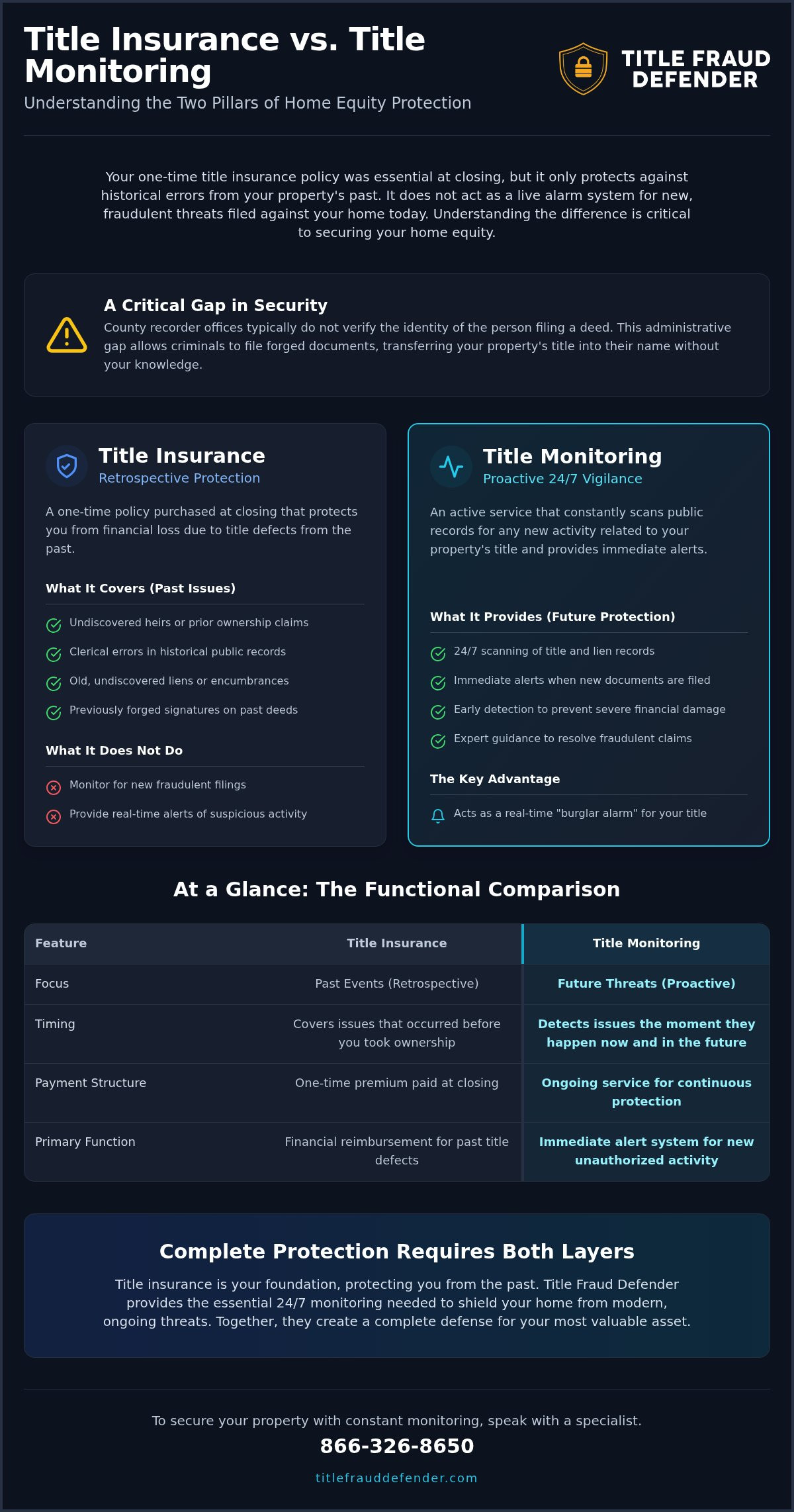
Title Monitoring vs. Title Insurance (The Functional Comparison)
To build a complete defense for your home equity, you must understand how these two services function side by side. Title insurance is a one-time purchase made at the closing table. It is a static contract that protects your financial interest against errors that happened in the past. In contrast, Title Fraud Defender provides an ongoing subscription service that watches your property records in real time. While the cost structures differ (one being a single upfront fee and the other a recurring protection plan) the type of threats they address are even more distinct. Insurance handles the legal cleanup of historical defects, while monitoring serves as the active alarm for new, unauthorized changes to your deed or liens.
Timing and Awareness
The “set it and forget it” nature of insurance is its greatest weakness when facing modern criminals. If a fraudster files a forged deed at the county office, your insurance company will not call you to report the activity. They simply don’t watch for it. This lack of awareness is a financial disaster for many senior homeowners. Being the last to know about a deed change means the criminal has time to take out a mortgage against your home and disappear with the cash. Title Fraud Defender provides an instant alert system that bridges this gap. Instead of waiting years to discover a problem during a home sale, you are notified the moment a document is recorded. This speed is the difference between a minor administrative fix and a total loss of equity.
Financial Defense vs. Legal Defense
Some critics argue that monitoring is unnecessary because it cannot physically stop a county clerk from accepting a forged document. This perspective ignores the reality of how property crimes are committed. While it’s true that county systems lack identity verification at the point of filing, the resulting financial damage is preventable through early detection. Title insurance provides a legal defense to eventually fix the title, but it doesn’t stop a criminal from stripping your equity in the meantime. By catching the filing early, Title Fraud Defender gives you the evidence needed to alert lenders and law enforcement before a fraudulent loan is ever issued.
Early detection is the most effective way to avoid a long legal battle that can last for months or years. Title Fraud Defender monitors both titles and liens, which is a common gap in many basic security plans. Unauthorized liens can be just as damaging as a deed transfer, yet they often go unnoticed for decades. If you have concerns about the current status of your property, you can start with a free title check or call a specialist at 866-326-8650 to discuss your protection options. Understanding the functional balance of title monitoring vs title insurance ensures that you aren’t just insured for the past, but protected for the future.
Identifying the Gaps in Traditional Homeowner Protection
Many homeowners believe that as long as they hold the physical deed to their house, their home is secure. This is a dangerous misconception. A criminal does not need to “steal” your title to strip your equity. They can simply file a fraudulent lien against your property. Because county record systems are often open to the public and lack rigorous verification for filings, these documents are recorded without question. This is a primary area where the debate of title monitoring vs title insurance becomes critical for your safety. Your insurance policy was likely a one-time purchase at closing. It rarely covers new, fraudulent liens filed years after the home purchase. Title Fraud Defender addresses these gaps by providing comprehensive lien reports that traditional insurance ignores.
The Threat of Fraudulent Liens
In plain language, a lien is a legal claim against your property used to secure a debt. If a homeowner does not pay a contractor or a tax bill, a lien can be placed on the home. Criminals exploit this system by filing fake mechanic’s liens or medical claims against properties they do not own. They don’t want your house. They want your money. When you eventually try to sell your home or refinance, these “invisible” claims appear in the title search. The fraudster then uses the lien to extort a settlement from your equity just to clear the title for the sale. Integrating property lien reports into your security strategy is the only way to catch these claims before they become a financial crisis.
The Problem with Free County Alerts
You might have heard that some local governments offer free property alerts. While these are a step in the right direction, they have significant limitations. Many counties in the United States still lack digital alert systems entirely. Even in counties that do offer them, the alerts are often vague and lack any form of expert support. If you receive a notice that a document was filed, you are left to handle the legal complexity alone. Title Fraud Defender provides national coverage and expert guidance that free services cannot match. It ensures that senior homeowners have a professional digital sentry watching their back across all jurisdictions. If a discrepancy is found, you can call a specialist at 866-326-8650 to receive immediate help with the resolution process.
Protect your equity with 24/7 monitoring and lien reports
Implementing a Comprehensive Shield with Title Fraud Defender
Building a complete defense for your home doesn’t mean replacing your existing coverage. The most effective security strategy involves keeping your title insurance and adding 24/7 monitoring to your toolkit. While insurance acts as a safety net for historical errors, monitoring serves as a live alarm for the future. Understanding the balance of title monitoring vs title insurance allows you to move from a vulnerable state to one of total oversight. Title Fraud Defender provides the missing link in property security by watching your records when you can’t. This dual approach ensures that your home equity is protected from both the mistakes of the past and the digital crimes of the present.
24/7 Vigilance and Peace of Mind
Many services simply notify you that a change has occurred and leave you to deal with the fallout alone. Title Fraud Defender provides a clear path to resolution. If an unauthorized filing is detected, you aren’t left to manage the legal complexity by yourself. Specialists are available to help you navigate the recovery process and provide the necessary guidance to stop a criminal in their tracks. This proactive approach is particularly important for protection for senior homeowners who are often targeted by sophisticated property scams. You can call 866-326-8650 for a consultation with a property security expert to discuss any concerns or alerts you receive.
A free title check is the best place to start for any homeowner concerned about their security. It provides an immediate baseline of your property’s current status and uncovers any existing “clouds” on your title. Once you know your title is currently clear, implementing a professional monitoring plan ensures it stays that way. This combined strategy of title monitoring vs title insurance creates an unbreakable shield around your greatest financial asset. It empowers you to enjoy your home with the confidence that someone is watching your title around the clock.
Secure Your Home Equity with Total Oversight
Your home is likely your most valuable asset and the foundation of your financial legacy. Protecting it requires more than just a one-time policy signed at a closing table years ago. Understanding the reality of title monitoring vs title insurance is the first step toward true security. While insurance offers a vital financial safety net for historical errors, it cannot alert you to a forged deed filed this morning. Real protection requires a proactive digital sentry that never sleeps.
Title Fraud Defender provides the 24/7 professional monitoring and comprehensive lien reports necessary to catch criminals before they can strip your equity. If a threat is detected, you have immediate access to expert guidance for fraud resolution. Don’t leave your property’s future to chance or outdated county systems that lack identity verification. You have the power to stay informed and in control of your property records at all times.
Frequently Asked Questions
Does title insurance cover title theft after I buy my home?
Standard title insurance is retrospective. It protects against claims that existed before your purchase, such as unknown heirs or old liens. It typically does not provide an active alert system for new, fraudulent deeds filed years after your closing date. While some enhanced policies offer limited post-policy coverage, they usually require the homeowner to discover the fraud first. This gap is why understanding title monitoring vs title insurance is essential for complete home equity protection.
Is title monitoring worth it if I already have insurance?
Yes, because these two services fulfill different security roles. Title insurance is a financial safety net designed to pay for the legal cleanup of past errors. Title monitoring is a proactive digital sentry that alerts you to current threats in real time. Without monitoring, you might not discover a forged deed until you try to sell your home. By then, a criminal could have already stripped your equity through fraudulent loans.
How do I know if someone has already stolen my home title?
You can determine the current status of your property by starting with a free title check from Title Fraud Defender. This initial review identifies any unauthorized changes currently recorded in your county public records. Common warning signs of existing fraud include receiving foreclosure notices for a mortgage you didn’t take out or missing property tax bills. A professional report provides the clarity you need to ensure your ownership remains intact.
Can a criminal really steal my house without me knowing?
Yes, because most county recorder offices do not verify the identity of the person filing a document. A criminal can submit a forged quitclaim deed that transfers your property into their name without your signature or knowledge. The county clerk simply records the document as presented. Once the deed is recorded, the fraudster can use your home as collateral for loans. Early detection through professional monitoring is the only way to stop this process.
What is the difference between title monitoring and “title lock”?
There is no functional difference, as “title lock” is often a marketing term for title monitoring services. It is technically impossible to “lock” a property title because county records are public systems that must remain open for filings. No private company can prevent a document from being submitted to the recorder office. Title Fraud Defender provides the monitoring and alerts you need to respond immediately if an unauthorized filing occurs. We put the products side by side in our rundown of better alternatives to Home Title Lock.
Does Title Fraud Defender provide legal representation?
No, Title Fraud Defender does not provide legal representation or lawyer services. Instead, the company provides expert guidance for fraud resolution. If an alert is triggered, property security specialists help you navigate the recovery process and provide the necessary evidence to work with law enforcement or lenders. This support ensures you have a clear path to follow rather than trying to handle a complex legal situation on your own.
How much does a property title monitoring service cost?
The cost of a property title monitoring service typically involves a recurring subscription fee rather than the one-time premium paid for insurance. While prices vary across the industry, the investment is generally modest compared to the potential loss of home equity. Title Fraud Defender offers various protection plans tailored to individual homeowners, bulk property owners, and lenders. You can call 866-326-8650 to discuss which plan best fits your specific security needs.
Can I monitor my own property title for free through the county?
Some counties offer free notification systems, but these services have significant limitations. Many jurisdictions still lack digital alert systems entirely, leaving gaps in your coverage if you own property in multiple areas. Professional services like Title Fraud Defender provide national oversight and expert support that free county alerts lack. Relying on manual checks is also discouraged, as criminals move quickly. Professional monitoring ensures you receive immediate notification of unauthorized activity.
The gap between insurance and monitoring widens for older homeowners, whose policies were written decades before the current wave of deed fraud. Our title protection for seniors checklist covers what that exposure actually looks like.