


Could an invisible debt be quietly draining the equity you’ve spent years building? Most homeowners assume their title is clear until they try to sell or refinance. By then, a hidden cloud or a fraudulent claim can stall your plans and cost you thousands. You need a way to see what the public records are hiding. A comprehensive property lien report is your first line of defense, acting as a digital sentry for your most valuable asset.
You deserve to feel secure in your home. It’s frustrating to deal with the confusion of public record searches or the fear of unknown creditors. We understand that anxiety. This guide provides a clear path to total clarity. You’ll learn how to identify hidden encumbrances and protect your property from the rising tide of title fraud. We will also cover critical updates for 2026, including the new FinCEN reporting fees and shifting statutes of limitations that impact your property rights. From detecting fraudulent filings to understanding municipal search costs, we’re giving you the tools to maintain absolute control over your equity. It’s time to stop worrying and start monitoring.
Key Takeaways
- Identify the difference between standard mortgages and hidden involuntary liens that cloud your title without warning.
- Expose hidden encumbrances like UCC filings and lis pendens by utilizing a comprehensive property lien report.
- Recognize why traditional title searches fail to provide long-term security and how modern monitoring fills the gap.
- Implement a two-step verification process, starting with a Free Title Check, to establish your property’s security baseline.
- Convert complex public records into instant, actionable alerts to stop fraudulent claims before they take hold.
What is a Property Lien Report and Why is it Critical?
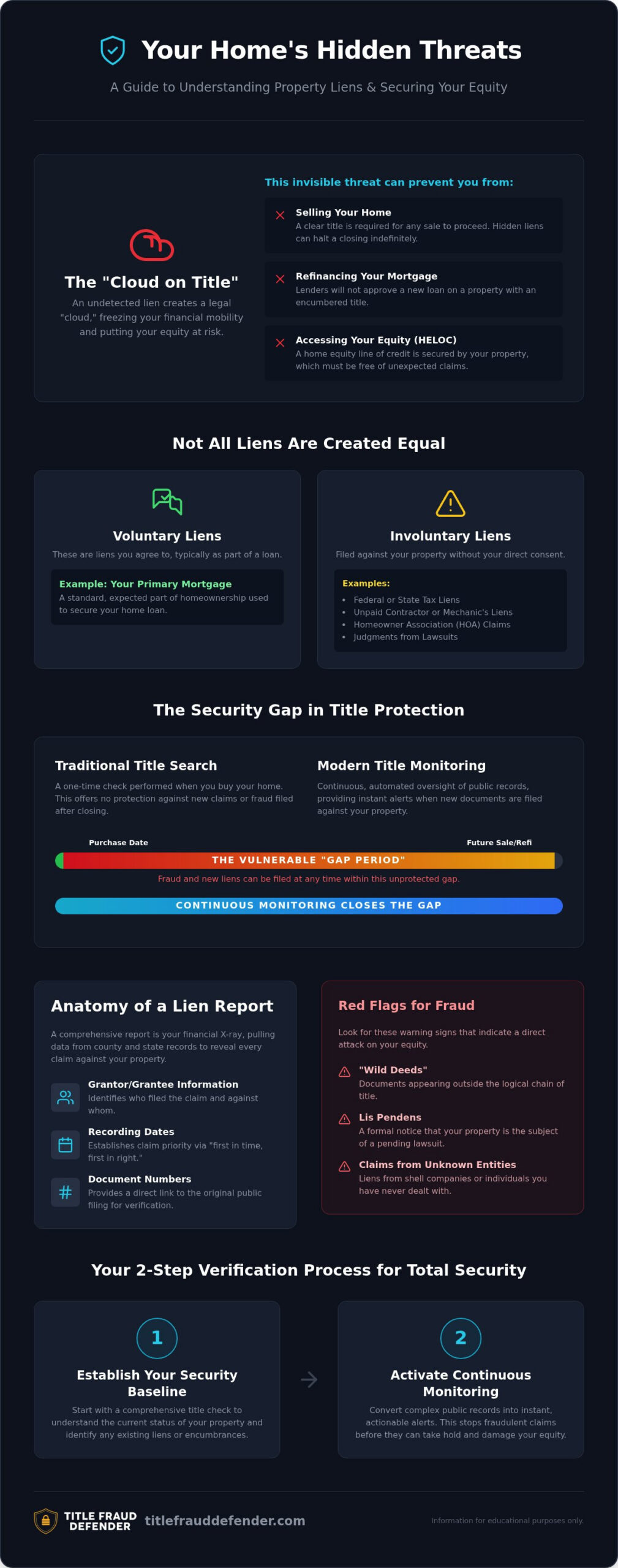
Your home is likely your most significant financial asset. Yet, most homeowners remain unaware of the invisible claims that can attach themselves to a property deed without a single signature. A property lien report acts as a comprehensive snapshot of these recorded encumbrances. It reveals every entity that has a legal stake in your equity, from your primary mortgage lender to a contractor claiming unpaid fees. Understanding What is a lien? is the first step in defending your ownership. In short, it is a legal right granted to a creditor until a debt is discharged. Without this clarity, you are flying blind.
The stakes are high. An undetected lien creates what professionals call a “cloud on title.” This isn’t just a legal footnote; it’s a total freeze on your financial mobility. Just as homeowners in Singapore use Prime Defectors to identify physical property defects before they become costly liabilities, a lien report protects you from legal “defects” on your title. You cannot sell your home, refinance your mortgage, or secure a home equity line of credit until that cloud is cleared. Creditors use these filings to ensure they get paid first, often leaving you with nothing at the closing table. Vigilance is your only protection against these silent threats.
The Hidden Danger of Involuntary Liens
Not all liens are created equal. While you chose your mortgage, involuntary liens arrive without your consent. Tax authorities, homeowner associations, or even a disgruntled repairman can file a claim against your property through a simple administrative process. These claims follow the “first in time, first in right” principle. This means the order in which liens are recorded determines who gets paid first during a sale. If a fraudulent or forgotten lien slips into the top spot, your bank or your own equity could be pushed to the back of the line. A statutory lien is a claim created by law rather than a contract, and it typically remains valid for a duration of 10 years.
Why One-Time Checks Aren’t Enough
Relying on a single search during your initial home purchase is a dangerous gamble. Fraudsters and aggressive creditors move fast. They exploit the “gap period” between traditional title searches to record fraudulent documents. By the time you discover the issue, the damage to your credit and equity is already done. A digital property lien report provides immediate clarity, but it is still only a single point in time. To truly secure your asset, you must bridge the gap between periodic checks and active oversight. Professional title monitoring services offer the constant vigilance required to catch these filings the moment they hit the public record. Don’t wait for a closing day disaster to find out your title isn’t clear.
The Anatomy of a Comprehensive Lien Status Report
A property lien report functions as a forensic map of your financial perimeter. It isn’t just a list of debts; it’s a verification tool that pulls data from multiple jurisdictions. Every comprehensive property lien report aggregates information from county recorders and state secretaries to provide a unified view of your asset’s health. Without this bird’s-eye view, you might miss a claim filed in a different department that still impacts your deed. To verify the integrity of your title, you must focus on specific data pillars:
- Grantor and Grantee Information: Identifies exactly who is claiming an interest in your property.
- Recording Dates: Establishes the priority of the claim in the “first in time” hierarchy.
- Document Numbers: Provides a direct link to the original filing for legal verification.
Beyond standard debts, a report exposes complex encumbrances that a simple search might overlook. This includes a lis pendens, which signals that the property is the subject of a pending lawsuit. It also identifies easements that grant utility companies or neighbors specific rights to use your land. Always double-check the legal description of the property. Addresses can change or be recorded incorrectly. The legal description, often using lot and block numbers, is the only definitive way to ensure the report matches your specific parcel of land.
Identifying Fraudulent Encumbrances
Fraud often hides in plain sight. Look for “wild deeds,” which are recorded documents that appear outside the chain of title. These are major red flags. Unauthorized signatures or liens from entities you’ve never heard of suggest a direct attack on your equity. For example, a federal tax lien is a legitimate government claim, but a lien from a shell company for “consulting services” is a warning sign. Interpreting these entries requires precision. Our Expert Guidance helps you decode suspicious report findings and determine if you are a victim of title fraud.
Understanding UCC-1 Filings on Real Estate
Some liens aren’t about your property title directly but about the equipment inside your home. UCC-1 filings often cover “fixtures” like solar panels, HVAC systems, or a whole house water filtration system. While these aren’t traditional mortgages, they act as clouds on your title. They can complicate or even block a property transfer if the lender isn’t satisfied. Many homeowners find “expired” UCC filings that were never officially cleared. Laws are shifting to address these lingering issues. For instance, Connecticut legislation effective in 2026 reduces the time for certain undischarged mortgages to become invalid from 20 years to 10 years. You must actively remove these old records to keep your title clean for future buyers.
Traditional Title Search vs. Modern Property Lien Monitoring
How much is your peace of mind worth? Traditional title searches are often slow, cumbersome, and expensive. Many title companies charge hundreds of dollars for a single search that can take days or even weeks to finalize. While a digital property lien report provides much faster access to critical data, you must understand the inherent flaw in any one-time check. The “snapshot” approach is fundamentally limited. It only shows you the state of your title at one specific second in time. The moment that report is generated, the information begins to expire. If a fraudster records a “wild deed” or a fake lien an hour later, your report is effectively useless. You’re left holding a map of a landscape that has already changed.
Relying on periodic checks leaves you vulnerable during the “gap period.” This is the window of time between searches where most equity theft occurs. You need more than a historical record; you need a “Digital Sentry” that never sleeps. A modern defense strategy moves beyond the static documents of the past and embraces active oversight. Many homeowners mistakenly believe that their title insurance policy provides this protection. It doesn’t. You must understand the difference between a safety net and a shield.
The Limitations of Title Insurance
Title insurance is a reactive product. It’s designed to protect you against defects that existed before you purchased the property, such as a missed heir or an unrecorded easement from decades ago. It’s an essential tool for closing, but it offers no protection against future fraudulent claims or new liens filed after your policy date. If a criminal targets your home tomorrow, your insurance won’t stop the filing. It simply sits in a drawer until you discover the damage years later. Insurance only pays out after the loss has occurred. To prevent the loss from happening in the first place, you need proactive monitoring. With real estate fraud losses in the United States reaching $275.1 million in 2025, implementing professional title fraud detection has become an essential component of any homeowner’s security strategy.
Benefits of Real-Time Lien Alerts
Speed is your greatest ally in the fight against property fraud. When a new document is recorded against your deed, you need to know immediately. Fraudsters count on the fact that most homeowners don’t check their title status for years at a time. This gives them a massive head start to borrow against your equity or even attempt to sell the property. Real-time alerts flip the script. By receiving an instant notification the moment a change is detected, you can take decisive action before the criminal can profit. Title Fraud Defender closes this dangerous security gap by providing the 24/7 vigilance your home deserves. It transforms a property lien report from a static document into a live defense system that keeps you in total control.
How to Obtain and Interpret Your Property Lien Report
Knowledge is only power when you act on it. Establishing a clear baseline for your property’s health requires a methodical, professional approach. Don’t settle for a manual search at a county recorder’s office. Those outdated methods are slow, incomplete, and prone to human error. Instead, follow this structured path to total title clarity and secure your equity against unseen threats.
First, establish your baseline with a Free Title Check. This identifies immediate, high-level threats to your ownership. Second, request a comprehensive property lien report for a deep dive into historical records. This uncovers older, “forgotten” claims that might have been missed during your initial purchase. Third, verify every name and entity listed as a “Lienor.” Do you recognize every creditor? Even a small, unfamiliar claim from a collection agency or a contractor can signal a much larger identity theft problem. Fourth, cross-reference document numbers with your own mortgage and closing papers. These numbers are unique identifiers. Discrepancies here often signal unauthorized or fraudulent filings recorded without your knowledge. Finally, secure the status quo with 24/7 monitoring. Stop future fraud before it has a chance to take root.
Reading Between the Lines: Spotting Errors
Public records are not infallible. Clerical errors are more common than you think. A typo in a parcel number or a misfiled document can create a “cloud” on your title that stalls your next financial move. Sometimes, a judgment against someone with a similar name accidentally attaches to your property. This “similar name” judgment can be a nightmare to untangle. If you are unsure where to begin, learning how to check for liens on my property through a structured process can help you identify these errors quickly. Immediate cloud on title detection is critical. If you spot an entry that doesn’t belong, use our Expert Guidance to begin the correction process before it impacts your credit or equity.
Action Steps for Real Estate Investors
Real estate investors face multiplied risks. Managing a portfolio means managing multiple vulnerabilities simultaneously. You cannot rely on manual checks for ten, twenty, or fifty properties. You need Bulk Property Protection to oversee every asset in your portfolio. Integrate a property lien report into your quarterly due diligence cycle. This ensures no junior liens, mechanic’s liens, or HOA claims slip through the cracks. For investors holding notes or private mortgages, lender collateral monitoring is an essential shield. It safeguards your security interests against senior lien threats that could wipe out your position in a foreclosure. Beyond protection, if you are seeking new opportunities, Landvoice provides the lead data on pre-foreclosures and FSBOs needed to grow your portfolio. Take control of your portfolio’s integrity today.
For investors looking to diversify their holdings into other regulated markets, you can explore EU‑regulated Ship Investment Bonds to access the maritime sector through a secure and compliant framework.
Securing Your Property with Title Fraud Defender
Property records are dense, fragmented, and intentionally difficult to navigate. You shouldn’t have to be a legal expert to protect your home. Title Fraud Defender acts as the ultimate proactive guardian by distilling these complex datasets into a single, clear stream of information. When you request a property lien report through our platform, we don’t just hand you a pile of documents. We provide a prioritized assessment of your title health. Our system highlights potential threats, identifies irregularities, and gives you a clear baseline for your security strategy. This moves you from a state of uncertainty to a position of total control.
For institutional lenders who must maintain this level of control across large portfolios, read more about selecting a mortgage BPO partner that offers precision and scalability.
Identifying a problem is only half the battle. If a suspicious entry appears on your report, you need immediate answers. This is where our Expert Guidance becomes your most valuable asset. We don’t just alert you to a threat; we provide a path to relief. Our specialists understand the nuances of fraudulent filings and can help you navigate the steps required to clear your title. This combination of digital precision and human expertise ensures that you are never left guessing about the security of your most valuable asset. It’s the difference between being a victim and being a victor.
The 24/7 Monitoring Advantage
The modern criminal doesn’t wait for business hours. They rely on the slow, manual processes of traditional title oversight to hide their tracks. Our 24/7 Title Monitoring technology closes that window of opportunity. By maintaining constant, automated oversight of public records, we catch unauthorized changes the moment they are recorded. Speed is the most critical factor in preventing deed fraud. If you wait until you receive a physical notice in the mail, the equity may already be gone. Our digital sentry works around the clock to ensure your deed remains untouched. Take the first step toward total property security by moving from reactive checking to proactive oversight.
Protecting Your Legacy and Equity
Your home represents years of hard work and a legacy for your family. Don’t leave its security to chance or outdated manual systems. A one-time property lien report is a vital tool, but it must be backed by a system that never sleeps. We offer a Free Title Check as a zero-risk starting point to establish your current security status. Establishing this baseline is the only way to ensure your equity remains yours. The threats are real, but they are also preventable with the right shield in place. Don’t wait for a crisis to act. Secure your home with Title Fraud Defender now and experience the peace of mind that comes from unwavering asset oversight.
Take Control of Your Property’s Future Today
Your home equity is too valuable to leave to chance. A property lien report provides the clarity you need right now, but it’s only the first step in a long-term defense strategy. Fraudsters and creditors often operate in the shadows of public records. You must transform your approach from reactive checking to constant vigilance. Don’t let an invisible debt or a fraudulent filing derail your financial future. You deserve total certainty regarding your most valuable asset, including its physical condition; for professional property inspections, read more.
True asset security requires a digital sentry that never sleeps. By utilizing 24/7 continuous monitoring and instant alerts on title changes, you can stop unauthorized claims before they take hold. If a threat emerges, expert fraud resolution guidance ensures you have a professional partner to navigate the recovery process. You’ve worked hard to build your equity. It is time to ensure it stays protected. For portfolio owners managing multiple properties, a dedicated bulk property protection strategy is the most effective way to scale your defenses across every asset you own. Start with a zero-risk baseline and secure your legacy today.
Get Your Free Title Check and Protect Your Equity Today
Frequently Asked Questions
What is included in a property lien report?
A comprehensive property lien report includes a detailed record of every entity with a legal claim against your asset. You will find grantor and grantee names, recording dates, and specific document numbers for verification. It also identifies voluntary mortgages alongside involuntary encumbrances like mechanic’s liens, HOA claims, and UCC filings. This data allows you to see exactly who has a stake in your equity.
Can someone put a lien on my house without me knowing?
Yes, a lien can be recorded against your property without your immediate knowledge. Involuntary liens, such as those from tax authorities or contractors, are filed through administrative processes that don’t require your signature. Fraudulent actors often use this gap in oversight to record “wild deeds” or fake claims. They hope you won’t notice the cloud on your title until you try to sell or refinance. Proactive cloud on title detection is the most effective way to catch these unauthorized filings before they cause lasting damage to your equity.
How long does a lien stay on a property title?
The duration depends on the lien type and local state laws. For example, a statutory lien often remains valid for a 10-year period before it must be renewed or expires. However, some states are shortening these windows. In Connecticut, new legislation reduces the time for certain undischarged mortgages to become invalid from 20 years to 10 years. Never assume a lien has simply vanished because time has passed.
Does a property lien report show up on my credit report?
Most property liens no longer appear directly on traditional credit reports from the major bureaus. However, the underlying debt that led to a judgment lien can still impact your credit score. More importantly, a lien on your property title is a public record. It will stop any future mortgage application or refinance in its tracks until the debt is fully satisfied and released.
What is the difference between a title search and a lien report?
A title search is a deep historical dive usually performed during a property purchase to establish a clean chain of ownership. In contrast, a property lien report is a focused, current snapshot of all active encumbrances on your deed. While a search looks backward through the entire history of the land, a report tells you exactly who has a claim on your equity today.
How do I remove a fraudulent lien from my property?
Removing a fraudulent filing requires decisive action and often involves filing a formal release or a “quiet title” action in court. You must first identify the unauthorized document number and the entity that filed it. Because these situations involve complex legal records, seeking Expert Guidance is the fastest way to clear a cloud on your title and restore your ownership rights before the fraudster can act.
Can I get a property lien report for free?
You can establish a baseline for your property’s security with a Free Title Check. This service identifies immediate red flags without an upfront cost. While a full, certified historical deep dive typically involves county recording fees, starting with a free assessment allows you to detect obvious threats. This is the most efficient way to determine if your equity is currently at risk.
How often should I check for liens on my property?
Manual checks should occur at least once a quarter to ensure no new claims have been filed against your deed. However, a “snapshot” approach always leaves a dangerous gap for fraud to occur. For total security, you should move beyond manual checks and implement 24/7 Title Monitoring. This ensures you receive an alert the second a new document hits the public record. Understanding the full process of how to check for liens on my property empowers you to stay ahead of threats and maintain complete control over your equity.