

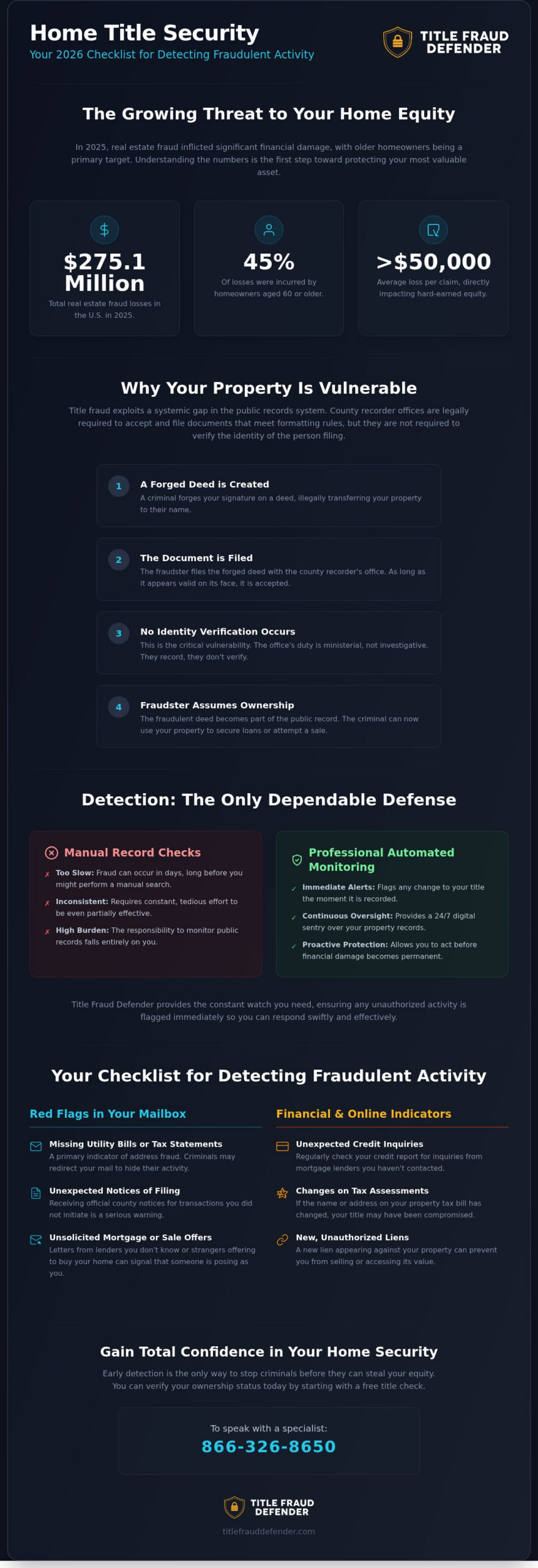
In 2025, real estate fraud losses in the United States reached $275.1 million. According to the FBI, homeowners aged 60 or older accounted for 45 percent of those financial losses, with average losses per claim exceeding $50,000. These figures highlight a growing threat to your hard earned equity. Implementing professional title fraud detection is now the most reliable way to secure your property against unauthorized transfers. You deserve to know that your home remains legally yours without having to manually check county records every week.
You likely worry about the hidden risks buried in public record systems that fail to verify identities. It is a valid concern because a forged deed can be filed in minutes. This guide provides a clear 2026 security checklist to help you identify red flags and protect your equity. You will gain a professional understanding of detection methods and learn how to receive instant alerts the moment a change is detected. Title Fraud Defender provides this roadmap to move you from uncertainty to total confidence in your home security.
Key Takeaways
- Learn why county recorder offices typically do not verify the identity of filers, leaving your property title exposed to unauthorized changes.
- Discover why early title fraud detection is the only dependable way to stop criminals before they can steal your equity or secure a fraudulent loan.
- Identify the warning signs of a forged deed, including missing utility bills or redirected property tax statements.
- Understand the limitations of manual record searches and why automated monitoring provides a more reliable shield for your home.
- Learn how to verify your ownership status today by starting with a free title check from Title Fraud Defender.
Understanding the Mechanics of Title Fraud Detection
Title fraud occurs when a criminal files a forged deed to transfer ownership of your property without your knowledge or consent. This is a specific, dangerous form of Mortgage fraud that targets your home equity directly. Once the document is filed, the fraudster appears as the legal owner in public records. They can then use this false status to secure loans or even attempt to sell the home. Effective title fraud detection is the only way to identify these changes before the financial damage becomes permanent.
County recorder offices operate on a ministerial basis. This means their legal duty is limited to ensuring a document meets basic formatting requirements. They are not required to verify the identity of the person filing the deed. This systemic vulnerability is not the result of staff error; it is simply how the American property record system was designed. Because the system assumes all filings are legitimate, the burden of monitoring remains entirely on you. While title protection focuses on digital monitoring, other investigative tools like those offered by Morgan Polygraph are used in legal settings to verify truth and debunk myths about deception detection.
How County Records Systems Work
Recorders must accept any document that appears valid on its face. If the signatures are notarized and the fees are paid, the document is usually accepted without question. The office then indexes the document, which means it is assigned to your specific property address or parcel number. Once indexed, it becomes a permanent part of the public record. Because there is no proactive identity verification at the point of filing, a criminal can easily insert themselves into your property’s history. This creates a hidden risk that many senior homeowners only discover after the equity has been stripped.
The Role of Technology in Modern Oversight
Modern title fraud detection relies on digital innovation to close the gap left by county systems. In the past, records were static books sitting on a shelf. Today, most counties digitize their filings. This allows for active monitoring streams that scan for new activity. This digital shift also enables advanced asset management solutions like the STO Foundation, which helps companies tokenize real-world assets and launch compliant investment offerings. An alert is a digital sentry that flags any change to your title the moment it is recorded, providing the immediate clarity you need to respond to a threat.
Manual checks are often too slow to be effective. A criminal can file a deed and secure a loan within a matter of days. By the time you check the records yourself, the damage is often done. Professional detection provides a continuous oversight loop. It ensures that any unauthorized document is flagged immediately. This speed is the only way to stop a criminal from using your home as collateral for their own gain. Title Fraud Defender maintains this constant watch so you don’t have to.
The Homeowner’s Checklist for Detecting Fraudulent Activity
Maintaining a vigilant routine is the most effective way to safeguard your property. You should begin by verifying your current ownership status through a free property title check to confirm that no unauthorized changes have already occurred without your knowledge. Successful title fraud detection is not a one-time event. It is a continuous process of observation that requires you to stay alert to changes in your official documents and financial records.
You must watch for unsolicited inquiries regarding the sale of your home. If strangers reach out with offers to buy your property or if you see your home listed for rent online, someone may be posing as the owner. Similarly, unknown mortgage solicitations or “thank you” letters from lenders you have never contacted are serious warning signs. These communications suggest that a criminal is actively attempting to use your home as collateral for a loan.
Immediate Red Flags in Your Mailbox
Your mailbox is often the front line of defense. If you suddenly stop receiving utility bills or property tax statements, take immediate action. This is a primary indicator of address fraud. Criminals often redirect official mail to a new address so you will not see the notices of their illegal filings. You should also be wary of receiving “notice of filing” documents from the county for transactions you did not initiate. According to the HUD Inspector General on Deed Fraud, these schemes often target homeowners with significant equity. Treat every unexpected piece of real estate mail with a high degree of scrutiny. If you suspect you have already been targeted, understanding how to report property fraud and stop title theft is the critical next step to protecting your equity.
Financial Indicators of Title Compromise
Your financial records offer critical clues that your property may be at risk. You should audit your credit report regularly for unexpected inquiries from mortgage lenders. A sudden inquiry could mean someone is trying to take out a loan in your name. You must also watch for changes in your property tax assessment notifications. If the name or address on the assessment has changed, your title has likely been compromised. Monitoring for new liens or encumbrances is equally vital. An unauthorized lien can prevent you from selling your home or accessing its value. For a deeper analysis of how these documents impact your security, read the Property Lien Report: The Definitive Guide to Protecting Your Home Equity.
Establishing a professional barrier between your home and these risks is essential for senior homeowners who want to protect their legacy. You can view monitoring options to see how Title Fraud Defender provides the oversight needed for lasting peace of mind. Catching these red flags early is the only way to stop a fraudster before they can strip your equity.
Comparing Manual Records Checks vs. Automated Monitoring
Manual property checks often feel like a responsible choice for homeowners. You might think that visiting the county recorder’s office or searching their website once a month is enough. However, this approach relies on a dangerous assumption that criminals work on your schedule. Modern title fraud detection requires a much faster response time. Fraudsters move with incredible speed. They can file a forged deed, obtain a cash-out mortgage, and disappear in the time it takes for you to plan your next manual audit.
The Limitations of DIY Property Audits
The primary weakness of a manual search is the “blind spot” that exists between checks. If you verify your title on the first of the month, a criminal has thirty days to exploit your property before you look again. Even when you do access the records, the data is often difficult to interpret. County websites use complex legal descriptions and indexing codes that can be confusing for a layperson. Misreading a single entry could lead you to believe your title is safe when it is actually under threat. For senior homeowners, this constant need for technical vigilance creates an unnecessary emotional burden. You shouldn’t have to spend your retirement acting as a part-time title clerk.
The Advantage of 24/7 Digital Sentries
Professional title fraud detection eliminates these vulnerabilities by replacing manual labor with constant, automated oversight. Title Fraud Defender scans public records 24/7 to identify any new documents indexed against your parcel. This digital sentry doesn’t sleep or take breaks. It provides a set-and-forget security layer that protects your largest financial asset without requiring your active participation.
When a change is detected, the value of an instant alert cannot be overstated. Speed is the only factor that prevents a fraudulent filing from turning into a total loss of equity. Automated monitoring ensures you’re the first to know about a change, not the last. Beyond the alert itself, Title Fraud Defender provides expert guidance to help you navigate the resolution process. If a red flag appears, you won’t be left to handle the legal fallout alone. You can call a specialist at 866-326-8650 to discuss your findings or start with a free title check. This proactive approach turns a complicated technical problem into a manageable sequence of steps, restoring your sense of control over your home’s future.
Why Detection is More Critical Than Prevention
Many homeowners believe they can simply “lock” their title to prevent any changes. Unfortunately, the legal reality of the American property system makes this impossible. County clerks have a ministerial duty to accept documents that appear valid on their face. This means there is no physical or legal barrier to stop a criminal from filing a forged deed. Because you cannot stop the filing, your only defense is speed. Effective title fraud detection allows you to identify the crime before a fraudster can move to the next stage of their scheme. Catching the act early is the difference between a minor legal hurdle and a total financial disaster.
The human stakes of this crime are incredibly high. Beyond the potential loss of your home equity, the legal costs to “quiet” a title (the legal process of clearing a fraudulent claim) can be staggering. The emotional toll of discovering your largest asset is at risk can be overwhelming. Professional detection acts as a protective shield that offers something title insurance does not: constant vigilance. While title insurance may help pay for legal fees after a loss is discovered, it does not watch your property 24/7 to ensure the loss never happens in the first place. Seeking title fraud expert guidance is the most effective way to understand how these systemic gaps can be closed before a criminal exploits them.
The Reality of the County Filing System
The open nature of public records is a fundamental part of property law. No “lock” or security software can legally prevent a county clerk from accepting a document that meets recording standards. This is why early detection is the only practical way to minimize your financial exposure. If you catch a forged deed immediately, you can alert law enforcement and lenders before a fraudulent loan is ever issued. This is especially critical for homeowners who have significant equity. Criminals often look for properties with little or no mortgage debt because they represent the path of least resistance for obtaining illegal cash. In contrast to these scams, homeowners seeking legitimate ways to access capital through vehicle-secured options can turn to V8Loans for professional financial services.
Protecting the Legacy of Senior Homeowners
Older adults are frequently targeted because they are more likely to have paid off their mortgages. A home without a mortgage represents a massive, unprotected pool of equity for a fraudster. Protecting this legacy requires more than just hope; it requires professional oversight. Title Fraud Defender provides specialized Title Fraud Protection for Seniors to ensure that your home remains yours. Expert guidance is a cornerstone of this protection. If a red flag is detected, you need a partner who can help you resolve the incident without panic. Moving from discovery to resolution requires a methodical approach that Title Fraud Defender has perfected. By combining rapid-fire alerts with expert support, you can maintain total control over your property’s future.
Securing Your Equity with Title Fraud Defender
Protecting your home requires a shift from reactive worry to proactive oversight. You have seen how county systems remain open to fraudulent filings and why manual checks leave dangerous gaps in your security. Title Fraud Defender bridges these gaps by providing a professional shield designed for the modern real estate environment. By implementing advanced title fraud detection, you ensure that your property is never left unwatched. This vigilance is the only dependable way to maintain your financial integrity.
To learn more about professional risk management and digital transformation in the financial sector, visit Versapien.
Comprehensive Oversight and Monitoring
The core of this protection is 24/7 Title Monitoring. This service removes the technical barriers that often prevent homeowners from effectively guarding their equity. You do not need to search confusing county databases or interpret complex legal codes. Title Fraud Defender handles the technical heavy lifting, scanning records continuously and notifying you the moment a change occurs. This constant presence is especially valuable for senior homeowners who want to maintain their independence without the stress of manual audits.
For those with multiple real estate investments, specialized bulk property protection for real estate portfolios is available. This ensures that every asset in your portfolio receives the same level of rigorous oversight. For business owners managing other complex assets, Admin316 provides a similar level of dedicated fiduciary administration for retirement plans, ensuring compliance and reducing risk. Whether you own a single family home or several rental properties, the goal remains the same: total clarity and immediate awareness of any unauthorized activity. The service is built to be frictionless, mirroring the ease of the protection it provides.
Just as you protect the data associated with your real estate portfolio, ensuring the privacy of your vehicle’s performance data is another way to maintain control over your assets; for specialized tools in this area, check out MileageBlocker.com.
Similarly, for business owners in the automotive sector, Verifacto provides the integrated loan and dealer management systems necessary to maintain oversight and security for large vehicle portfolios.
If an alert is triggered, you are not left to face the situation alone. Expert Guidance is included to help you take the right steps immediately. This support is critical for resolving incidents before they escalate into long term legal battles. Additionally, a Lien Report can provide a deep dive into any unauthorized claims against your home equity. This gives you the documentation needed to clear your title and restore your security. Professional title fraud detection turns a complicated problem into a manageable sequence of steps.
Taking the First Step Toward Security
Establishing a baseline of safety is the first priority. You can start with a free property title check to verify your current ownership status and identify any existing red flags. This simple step provides immediate peace of mind and ensures that your monitoring begins on a clean slate. The signup process is streamlined and effortless, reflecting a commitment to making professional protection accessible to everyone. You deserve the confidence that comes from knowing a digital sentry is watching over your largest asset.
You have worked hard to build your home equity. Do not leave it exposed to unseen risks. You can speak with a specialist at 866-326-8650 to learn more about how to secure your property. You are invited to View Pricing and Protect Your Title to begin your journey toward total property security.
Take Control of Your Property Security Today
Your home equity represents years of hard work and careful planning. You cannot rely on county recorder systems to verify the identity of those filing new deeds against your parcel. Professional title fraud detection provides the only continuous oversight capable of identifying unauthorized changes before they result in permanent financial loss. This proactive approach ensures your home remains a safe harbor for your family and your legacy. It’s a necessary step for any homeowner who values financial integrity.
Title Fraud Defender offers the essential tools for 24/7 title and lien monitoring to keep your property secure. You can establish a clear baseline of safety with a free title check available right now. If a red flag appears, title fraud expert guidance for resolution ensures you have a knowledgeable partner to help clear your title and restore your peace of mind. Moving from uncertainty to total confidence is a simple, effective choice for your property’s future. This level of oversight doesn’t just watch your home; it protects your future.
You have the power to protect your largest asset from unseen risks. Secure your property today and enjoy the reassurance of a home that is always being watched by a dedicated guardian.
Frequently Asked Questions
How does title fraud detection actually work?
It works by continuously scanning digital county records for any new documents indexed against your property’s legal description. Title Fraud Defender uses automated streams to monitor for deed transfers, mortgage filings, or new liens. When a document is recorded, the system matches it against your baseline and triggers an alert if the activity is unauthorized. This constant oversight ensures that no change goes unnoticed for long.
Can I monitor my property title for free on my own?
You can manually check county websites or visit the recorder’s office, but this is often unreliable and time consuming. While some counties offer free alert services, these systems are typically limited to specific jurisdictions and often lack the comprehensive lien monitoring found in professional services. Relying on manual checks creates dangerous blind spots between your searches that criminals can easily exploit to steal equity.
Is title fraud detection the same as title insurance?
No, title insurance and title fraud detection are two different forms of protection. Title insurance is a reactive policy that may cover legal costs after a loss occurs. In contrast, detection is a proactive monitoring service that alerts you to changes as they happen. This allows you to stop a criminal before they can strip your equity or sell your home to an unsuspecting buyer.
How quickly will I be notified if a change is made to my deed?
Notifications are sent as soon as a new document is indexed in the county’s digital record system. Professional title fraud detection aims for near-instant alerts to ensure you have the maximum time to respond. Rapid notification is the only way to intervene before a fraudster secures a mortgage or transfers ownership to a third party. Speed is your best defense against financial damage.
What should I do if I receive an alert that my title has changed?
You should immediately contact Title Fraud Defender to review the alert and verify if the activity was authorized. If the filing is fraudulent, you will receive expert guidance on the specific steps needed to notify law enforcement and the county recorder. Taking quick, methodical action is essential for minimizing the legal and financial fallout of a forged deed. You can also call a specialist at 866-326-8650 for support.
Does Title Fraud Defender protect more than one property?
Yes, Title Fraud Defender offers specialized bulk property protection for homeowners and investors with multiple real estate assets. This service ensures that every property in your portfolio receives constant, 24/7 monitoring under one umbrella. Whether you own a second home, a vacation cottage, or a series of rental units, each title is watched with the same level of professional vigilance and care.
Why are seniors more at risk for property title fraud?
Seniors are often targeted because they typically have higher levels of home equity and may have paid off their mortgages entirely. A home without a mortgage represents an easier target for criminals looking to secure fraudulent loans. Additionally, fraudsters may assume that older homeowners are less likely to monitor digital county records regularly. Protecting this hard earned legacy requires a more proactive approach than simple manual observation.
Can a “title lock” really stop someone from filing a deed?
No, a “title lock” cannot physically or legally prevent a county clerk from accepting a document for filing. Because county records are open to the public, clerks must record any document that meets basic legal requirements. The term is a misnomer; the only real protection is a detection system that alerts you to the filing immediately so you can take action. You cannot lock the records, but you can certainly watch them. If you do discover an unauthorized filing, knowing exactly how to report property fraud and stop title theft in 2026 will help you act swiftly to protect your home.