

What if a total stranger could sell your house right from under you without ever stepping foot on your porch? It sounds like a nightmare, but deed fraud is a silent reality that strips homeowners of their equity through digital loopholes. You’ve worked hard to build your life, and the thought of losing it to an invisible criminal is genuinely terrifying. Learning how to monitor property title records is no longer a luxury; it’s a vital necessity for your financial survival. You deserve the peace of mind that comes with knowing your home is safe.
We promise to provide the most effective methods to watch over your deed and stop fraud before it can take root. This guide simplifies the complex world of county recordings into a clear, manageable action plan for 2026. We’ll walk through manual oversight techniques, the power of automated alerts, and exactly what to do if you detect unauthorized activity. It’s time to replace your anxiety with a professional strategy that keeps you in total control. Let’s build your digital shield and secure your equity today.
Key Takeaways
- Identify title monitoring as your primary defense against silent deed transfers and equity theft.
- Master the manual steps for searching county recorder portals to verify your current property status.
- Discover how to monitor property title records while navigating the limitations of fragmented government alert systems.
- Upgrade to 24/7 automated oversight to receive instant notifications the moment a change is detected.
- Take immediate action with a free title check to confirm your home equity is secure today.
What is Property Title Monitoring and Why is it Essential?
Your home is likely your most significant financial asset. It represents years of hard work, savings, and security. However, that security is under constant threat from digital predators who operate in the shadows of public records. Property title monitoring is the continuous, automated oversight of these records. It ensures that any change to your ownership status is identified immediately. Think of it as a motion sensor for your legal deed. Without it, you are essentially leaving your front door wide open to identity thieves and professional fraudsters.
In 2026, the speed of digital filing has outpaced traditional verification methods. Criminals can forge your signature, file a fraudulent deed, and vanish before you even check your mail. This is why knowing how to monitor property title changes is no longer optional. It acts as an early warning system. By catching a fraudulent transfer the moment it is recorded, you can stop the damage before a criminal takes out a massive loan against your equity or attempts to sell the property to an unsuspecting buyer. Understanding the full scope of home title fraud in 2026 and how it threatens your property equity is the first step toward building an effective defense.
Monitoring vs. Title Insurance: Clearing the Confusion
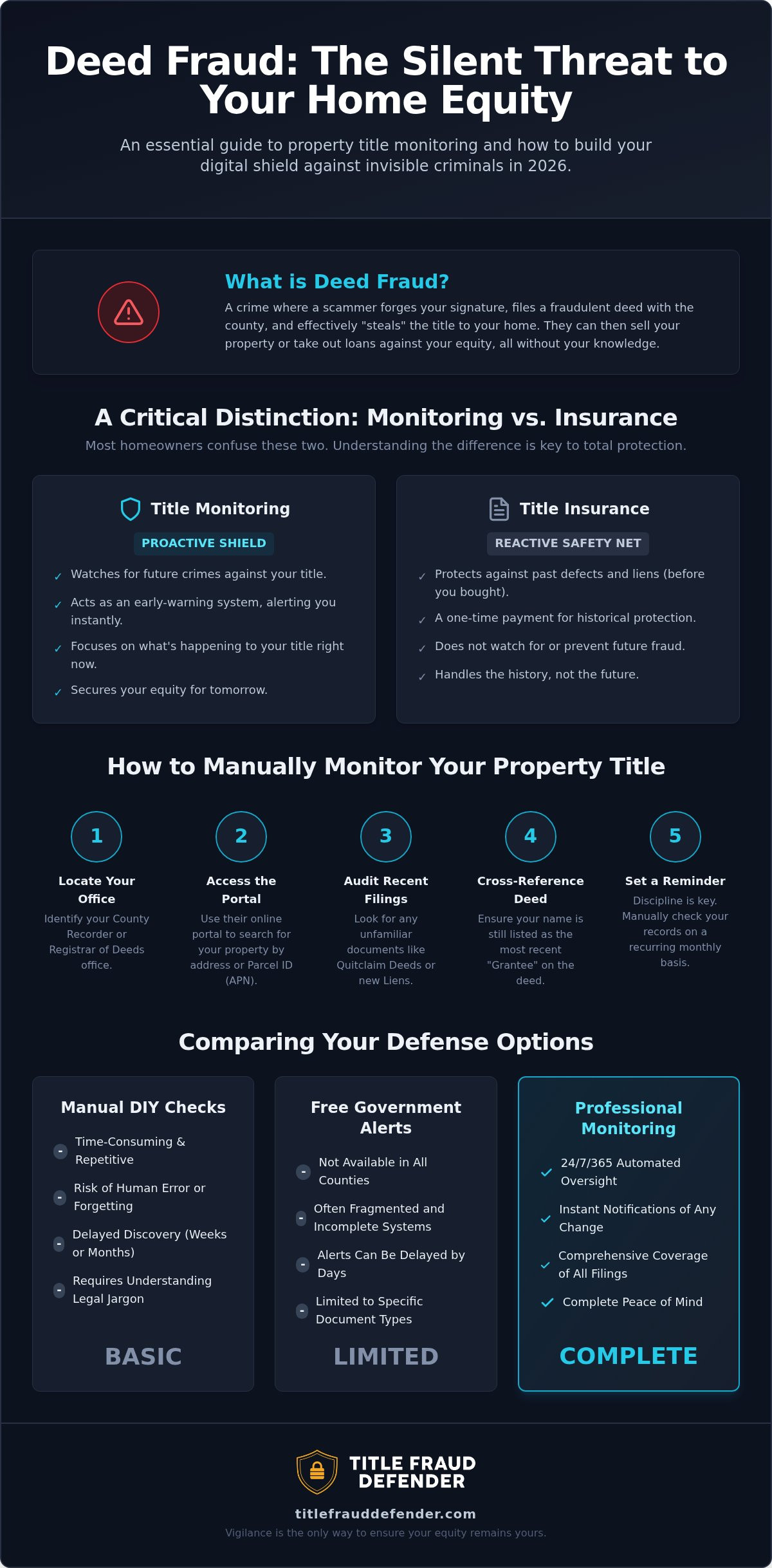
Many homeowners mistakenly believe their title insurance policy protects them from deed fraud. This is a dangerous assumption. Title insurance is a reactive safety net. It protects you against defects and liens that existed in the past, before you took ownership. It does not watch for future crimes. Title monitoring, conversely, is a proactive shield. It focuses on what is happening to your title right now and in the future. To achieve total property integrity, you must use both. While insurance handles the history, monitoring secures your tomorrow. Think of insurance as the parachute and monitoring as the radar system that prevents the crash.
The Anatomy of a Property Title Change
Every time a property changes hands or a loan is secured, a document is recorded at your local County Recorder or Registrar of Deeds. This public system is the foundation of property ownership, but it is also a target. Criminals frequently target specific documents to execute their schemes:
- Quitclaim Deeds: These are often forged to quickly transfer ownership without a formal title search.
- Warranty Deeds: Fraudsters use these to “guarantee” a clean title to a secondary buyer after stealing the property.
- Deed of Trust: Forged to secure illegal loans against your home equity.
When an unauthorized document is filed, time is your only ally. An instant alert allows you to contact the authorities and the recording office immediately. This swift action can freeze the process. It prevents a fraudulent loan from being finalized and saves you from a legal nightmare that could take years to resolve. Vigilance is the only way to ensure your equity remains yours.
How to Monitor Your Property Title Yourself (Manual Methods)
Taking control of your home’s security starts with a direct audit of public records. While automated systems provide the highest level of defense, you can begin the process yourself. Understanding how to monitor property title records manually is the first step toward ownership security. It requires discipline and a methodical approach to ensure no unauthorized document slips through the cracks. Follow these steps to verify your ownership status today.
- Identify your local office: Locate your County Recorder or Registrar of Deeds. This is the official government body responsible for maintaining all land records in your jurisdiction.
- Access the online portal: Most counties now offer digital archives. Use your specific Parcel ID (APN) or property address to pull up your history. Searching by Parcel ID is more accurate, as it eliminates confusion with similar street names.
- Audit recent filings: Look closely at the “Recent Filings” or “Document History” section. Check for any unfamiliar document types such as Quitclaim Deeds, Liens, or Deeds of Trust that you didn’t personally authorize.
- Cross-reference your deed: Compare the most recently recorded document with your physical copy. Ensure the “Grantee” (the person receiving the property) is still you. Any discrepancy here is an immediate red flag.
- Set a recurring reminder: Mark your calendar for a monthly audit. Consistency is your only defense when performing these checks by hand.
If you aren’t sure where to begin, you can start with a free title check to see exactly what is currently recorded against your property. This gives you a clean baseline for your manual monitoring efforts.
Navigating the County Recorder’s Office
Searching digital archives effectively requires a basic grasp of legal terminology. The Grantor is the person transferring the interest, while the Grantee is the person receiving it. When you bought your home, you were the Grantee. If you see your name in the Grantor column on a document you didn’t sign, someone may be attempting to transfer your title. If your county lacks an online portal, you must visit the office in person to request a “Title Search” or “Grantor/Grantee Index” report. Don’t ignore encumbrances, these are claims or liens against your property that could signal financial fraud.
The Risks of the “Do-It-Yourself” Approach
Manual monitoring has significant vulnerabilities. The primary danger is the “time gap.” If you check your records on the first of the month and a criminal files a fraudulent deed on the second, you’re exposed for nearly 30 days. In that time, a fraudster can vanish with your equity. Managing this process for multiple properties or across different counties becomes a logistical nightmare. For professionals who are frequently on the road, such as those who learn more about The Truckermann, the emotional burden of constant vigilance is even higher. You shouldn’t have to spend your weekends playing detective to feel safe in your own home. Manual checks are a good start, but they lack the real-time response needed to stop modern criminals.
The Limitations of Free Government Alert Systems
Many local governments have recently recognized the rise in deed theft. In response, they’ve launched free “fraud alert” services. These programs are a positive step. They show that officials take the threat seriously. However, relying solely on a free government system creates a dangerous sense of false security. These alerts are almost always “opt-in.” This means if you haven’t manually registered your name with the county recorder, you have zero protection. Even if you do register, the system is only as good as the local database it pulls from. It’s a start. It’s not a solution.
The biggest drawback is the lack of support. A government alert is just a notification. It tells you that a document was filed. It doesn’t tell you if that document is legal or fraudulent. It doesn’t provide a clear action plan. When you receive an alert at midnight, who do you call? The county clerk won’t give you legal advice. You’re left to navigate a complex legal minefield on your own. This gap between detection and resolution is where many homeowners lose their equity. Learning how to monitor property title records through a county portal is a smart first step, but it shouldn’t be your last.
Why “Free” Can Be Costly in the Long Run
Free systems often suffer from delivery delays. In the world of property fraud, hours matter. A sophisticated criminal can record a deed, secure a loan, and disappear in a single afternoon. If your free alert arrives two days late, the damage is already done. Beyond timing issues, these systems often trigger for every “name match” in the county. This leads to frequent false positives. You might receive an alert for a different person with the same name. This causes unnecessary panic and leads to “alert fatigue.” You might ignore a real threat because of past false alarms. Free alerts also lack expert interpretation. You’re forced to decipher complex legal filings without professional guidance. Before investing in any protection product, it’s worth understanding the critical differences in a title lock vs title monitoring service to ensure you’re getting real oversight and not just a marketing slogan.
Fragmented Protection in a National Market
Our property records system is hyper-local. There are over 3,000 counties in the United States. Each one has its own rules, portals, and alert systems. If you own a vacation home in a different state or manage a small portfolio of rentals, you’re forced to manage multiple accounts. This fragmentation leaves massive holes in your defense. A unified national monitoring service eliminates this chaos. It provides a single, secure dashboard for all your assets. You get consistent, real-time oversight regardless of where your property is located. This is the professional way to handle how to monitor property title changes. It moves you from a patchwork of local alerts to a comprehensive national shield.
Professional Monitoring: 24/7 Vigilance for Your Home Equity
Manual checks and government alerts provide a starting point, but they don’t offer a complete defense. Professional 24/7 Title Monitoring acts as a digital sentry that never sleeps. It utilizes automated technology to scan county databases every hour of every day. This eliminates the “time gap” where criminals thrive. When you understand how to monitor property title records professionally, you realize that speed is your greatest asset. You receive an instant alert via SMS or email the moment a document is recorded. This rapid response allows you to stop fraud before it results in financial ruin.
Professional services go beyond simple notifications. They provide expert guidance to help you interpret complex legal filings. A government alert might tell you a document was filed, but it won’t tell you what it means. Our experts help you understand the gravity of the situation and outline your legal next steps. This level of oversight ensures you aren’t just notified of a problem; you’re equipped to solve it. It’s time to move from passive observation to active defense.
Key Features to Look for in a Monitoring Service
Not all monitoring services are created equal. You need a system that prioritizes real-time detection over delayed reporting. A delay of even 24 hours can be the difference between stopping a crime and losing your home. Look for a provider that offers comprehensive coverage of all document types. This includes deeds, mortgages, and specific Lien Reports. A truly effective service also provides access to historical data. Starting with a Free Title Check allows you to establish a clean baseline for your property’s history and see exactly how to monitor property title changes effectively.
Detecting Clouds on Title and Fraudulent Liens
A “Cloud on Title” is any claim that makes your ownership status unclear. It acts as a legal roadblock. It prevents you from selling your home or refinancing. Criminals often use fraudulent mechanics liens to create these clouds. They hope you’ll pay a “settlement” just to clear the record. Monitoring for these hidden threats is essential for lender collateral security. It ensures no unauthorized financial claims are attached to your asset. By maintaining constant vigilance, you keep your title clear and your equity protected from predatory filings.
Secure Your Property with Title Fraud Defender
You’ve seen the risks. You understand that manual checks and free alerts leave doors open for criminals. Title Fraud Defender is built to close those doors forever. We act as your ultimate digital shield. By combining 24/7 monitoring with expert oversight, we ensure your equity remains exactly where it belongs: with you. Knowing how to monitor property title records is about more than just data. It’s about having a proactive guardian that never blinks.
Our service is designed to be high-impact but effortless for the homeowner. We remove the technical barriers that make county portals so frustrating. You don’t need to be a legal expert to protect your home. We handle the complex scanning and deliver clear, actionable results to your inbox. Start with our Free Title Check to see your current status. This simple step establishes your baseline and gives you immediate clarity on your property’s integrity.
Expert Guidance When You Need It Most
A notification is only the beginning. When our system detects a suspicious filing, you aren’t left to figure it out alone. This is where Title Fraud Defender truly stands apart from government alerts. Our experts review the discrepancy and provide immediate guidance. We help you understand the document’s legal impact. Then, we walk you through the resolution process. Whether it’s contacting local authorities or filing a dispute, we’re your dedicated guardian. You gain the peace of mind that comes from having a professional partner in your corner during a crisis.
Start Your Protection Journey Today
Don’t wait for a crisis to secure your legacy. Fraudsters move fast, but you can move faster. By implementing a professional strategy for how to monitor property title changes, you stay ahead of the threat. For those with multiple assets, we offer Bulk Property Protection. This ensures every piece of your portfolio is under our 24/7 watch. It’s a low-cost essential that protects your most valuable asset from invisible risks, much like how IronClad Family secures your other vital digital documents.
- Immediate Clarity: Use the Free Title Check to audit your current deed status.
- Constant Vigilance: Activate 24/7 monitoring for real-time peace of mind.
- Expert Support: Access guidance to navigate complex legal filings and fraud.
Take the first step toward total property security. Secure your home, your equity, and your future. Visit Title Fraud Defender and activate your shield today. Your legacy is too important to leave to chance.
Take Decisive Action to Shield Your Home Equity
Your property title is the legal key to your financial future. As we’ve explored, relying on manual monthly checks or fragmented government alerts leaves you vulnerable to fast-moving digital criminals. Learning how to monitor property title changes is a vital skill, but true security requires a digital sentry that never sleeps. You need a system that detects threats in real-time and provides the expert guidance necessary to fight back immediately.
Protecting your legacy shouldn’t be a source of constant stress. By choosing professional oversight, you gain access to 24/7 vigilant monitoring and comprehensive lien reporting. This proactive approach ensures that any unauthorized document is identified and resolved before it can damage your credit or ownership. Stop the threat before it starts and reclaim your peace of mind today. It’s time to move from passive observation to active defense.
Get Your Free Title Check from Title Fraud Defender and put our expert resolution guidance to work for you. You’ve built a valuable life; let’s make sure it stays yours. Your home is your fortress, and we’re here to help you defend it.
Frequently Asked Questions
How often should I monitor my property title?
Real-time monitoring is the only way to ensure total security for your home equity. Criminals can file a fraudulent deed and secure a loan in a single day. If you choose to check records manually, you should do so at least once a month. However, a monthly check still leaves a 30-day window for a fraudster to vanish. Automated 24/7 oversight is the only method that eliminates this dangerous gap.
Can someone really steal my house deed without me knowing?
Yes, deed theft is a silent crime that occurs entirely within public record databases. A fraudster simply files a forged document with the county recorder to transfer ownership. Because most recording offices don’t verify signatures or identities at the time of filing, the change happens instantly. You won’t receive a notification from the government until the damage is already done. This makes proactive oversight your only real defense.
Does title monitoring prevent fraud or just alert me to it?
Monitoring acts as a high-speed early warning system rather than a physical lock. It doesn’t stop a document from being filed, but it alerts you the second it happens. This speed is critical for your protection. By knowing how to monitor property title records effectively, you can contact authorities and lenders immediately. Rapid intervention is what actually prevents the criminal from successfully cashing out your equity.
What is the difference between deed fraud and title fraud?
Deed fraud specifically refers to the illegal transfer of ownership through forged documents. Home title fraud is a broader term that includes deed theft, fraudulent liens, and unauthorized loans. Both are devastating to your financial health. Both require constant vigilance. A professional monitoring service is designed to detect any unauthorized change to your public record, regardless of the specific legal document used by the criminal.
Is title monitoring the same as other property protection services?
While many services exist with varying names, the core function of title monitoring is to provide a digital sentry for your home equity by watching public records for unauthorized changes. The most important factors to consider are the speed of the alert and the quality of support provided. If you’ve seen advertisements for title lock products, it’s important to understand the real differences between a title lock vs title monitoring service before making a decision. A service like Title Fraud Defender offers 24/7 monitoring and expert guidance to help you resolve any issues the moment they arise, ensuring comprehensive protection.
What should I do first if I receive a title fraud alert?
Contact your monitoring provider’s expert support team immediately. They’ll help you verify the filing and determine if it’s a legitimate error or a criminal act. Your next steps include notifying the county recorder, contacting local law enforcement, and alerting your mortgage lender. Speed is your best defense in these situations. Don’t wait for the situation to escalate; act the moment you receive the notification.
Can I monitor my property title for free through the government?
Many counties offer free fraud alerts, but these systems are often fragmented and reactive. You must manually sign up for each specific jurisdiction where you own property. These programs generally notify you after a document is recorded but offer no expert guidance on how to fix the problem. For comprehensive protection, a professional service provides a unified national dashboard and active support when you need it most.
Does title monitoring protect against fraudulent liens?
Yes, a comprehensive monitoring service tracks all documents filed against your parcel, including mechanics liens and tax liens. Criminals often use fake liens to cloud your title and demand illegal “settlement” payments. By understanding how to monitor property title changes, you can detect these fraudulent “clouds” instantly. This allows you to dispute the filing before it interferes with a future sale or refinance of your home.