
What if the real estate assets securing your portfolio were compromised without you ever receiving a notification? It is a risk you cannot afford to ignore. While you performed due diligence at closing, title risks do not end when the loan is funded. Criminals often target equity through sophisticated deed fraud or by placing unauthorized encumbrances on properties long after the deal closes. This is why lender collateral monitoring has become an essential shield for modern institutions. It transforms your approach from reactive recovery to proactive defense.
You understand that manual county record checks are slow and inefficient. Relying on outdated methods leaves your security interests vulnerable to hidden liens that may only surface during a default or sale. Title Fraud Defender provides the constant vigilance needed to protect your investments. This article explores how proactive title and lien monitoring secures your assets against the evolving threats of fraud. You will learn how automated oversight can streamline your operations, reduce the risk of collateral loss, and provide immediate clarity for large property portfolios.
Key Takeaways
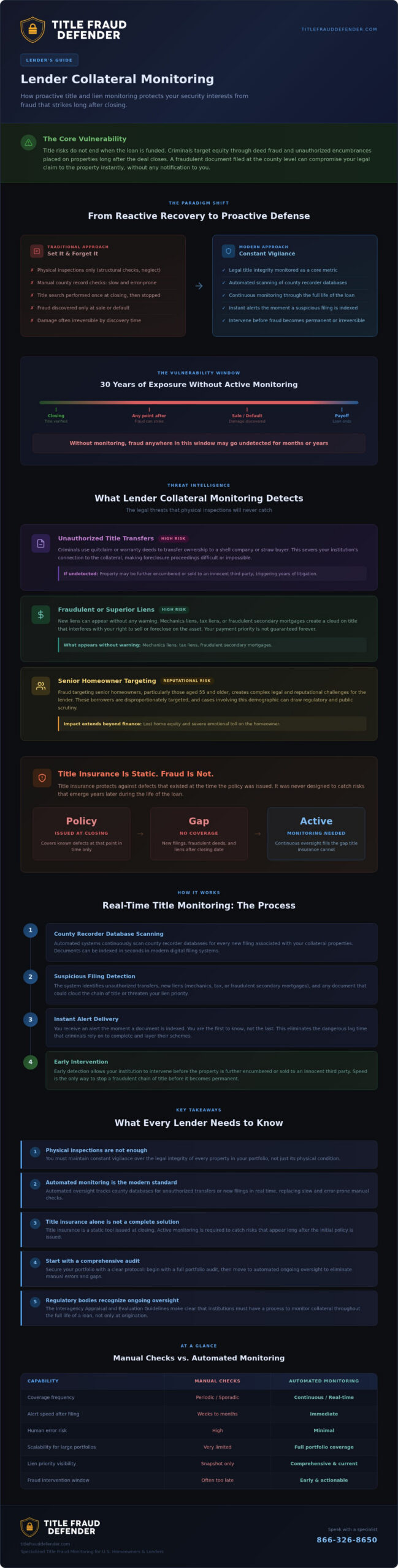
- Physical inspections are not enough to protect your assets. You must maintain constant vigilance over the legal integrity of every property in your portfolio.
- Modern lender collateral monitoring provides an automated shield by tracking county databases for unauthorized transfers or new filings in real time.
- Title insurance is a static tool. Learn why you need active monitoring to catch risks that appear long after the initial policy is issued.
- Secure your investments with a clear protocol. Start with a comprehensive audit and move to automated oversight to eliminate manual errors.
- Let Title Fraud Defender serve as your digital sentry. Access specialized bulk protection plans and deep-dive lien reports to maintain total control.
Understanding Lender Collateral Monitoring in Modern Real Estate
Lender collateral monitoring is the practice of continuous, automated oversight for assets pledged to secure a loan. It represents a fundamental shift in how financial institutions manage risk. For decades, the focus remained on physical property inspections. Lenders checked for structural damage or neglect to ensure the asset’s value. While physical upkeep still matters, the modern threat is often invisible. Legal title integrity has become the new frontline. Your security interest lives and dies by the accuracy of county records. If a fraudulent document is filed, your legal claim to the property can be compromised instantly.
Maintaining the priority of your lien is the primary goal of this oversight. You cannot rely on the assumption that your position remains secure just because it was verified at closing. Title Fraud Defender acts as a digital sentry, watching for any changes that could jeopardize your standing. This proactive approach ensures that your institution remains informed of any activity that might affect the asset’s legal status.
The Legal Foundation of Your Security Interest
Your mortgage or deed of trust is only as strong as the title it is attached to. If an unauthorized title transfer occurs, it can sever your institution’s connection to the collateral. Fraudulent deeds are a major risk because they cloud the chain of title. This makes it difficult or impossible to initiate foreclosure proceedings when a borrower defaults. You must view legal ownership status as a metric just as vital as the property’s market value. A clear understanding property liens and how they are recorded is essential for any risk officer. When a criminal files a forged deed, they effectively steal the anchor of your loan. Title Fraud Defender monitors these filings to ensure your anchor stays firmly in place. This protection is especially critical when dealing with senior homeowners, as fraud targeting this demographic can lead to complex legal and reputational challenges for the lender.
Risk Factors in Traditional Collateral Management
Traditional management often leaves a massive window of vulnerability. This gap exists between the day a loan closes and the day it is paid off. Most institutions perform a title search at the beginning but then stop looking for the next thirty years. This set it and forget it mentality is dangerous. Manual title searches at the county level are slow and prone to human error. They cannot keep pace with modern fraud.
Digital filing systems have streamlined the recording process. While this is efficient for legitimate business, it also allows fraudsters to record documents with incredible speed. Without automated lender collateral monitoring, you are essentially flying blind. You might not realize a fraudulent lien or deed has been filed until you attempt to sell the loan or manage a default. By then, the damage is often irreversible. Protecting your portfolio requires a move away from periodic checks toward constant, real-time vigilance. Understanding the full scope of real estate title security is essential for any institution looking to safeguard its collateral against the evolving fraud landscape of 2026 and beyond.
The Mechanics of Real-Time Title and Lien Oversight
Real-time oversight acts as a digital sentry for your portfolio. It replaces the slow, manual process of checking county records with automated tracking. These systems scan recorder databases for every new filing associated with your collateral. This constant surveillance is vital in a digital environment where documents can be recorded in seconds. Effective lender collateral monitoring ensures you are the first to know when a change occurs, not the last. You receive an instant alert the moment a document is indexed. This eliminates the dangerous lag time that criminals rely on to complete their schemes.
Detecting Unauthorized Title Transfers
Forged deeds are a direct attack on your security interest. Criminals often use quitclaim or warranty deeds to transfer ownership to a shell company or a straw buyer. If this goes undetected, the connection between your loan and the property is severed. Title Fraud Defender flags these suspicious filings immediately. Early detection allows you to intervene before the property is further encumbered or sold to an innocent third party. This speed is the only way to avoid years of expensive litigation. You must be able to stop a fraudulent chain of title before it becomes permanent.
Monitoring for Fraudulent or Superior Liens
Your payment priority is not guaranteed forever. New liens can appear without any warning to the lender. Mechanics liens, tax liens, or even fraudulent secondary mortgages create a cloud on title. These issues interfere with your rights to sell or foreclose on the asset. You need a clear view of the current lien landscape at all times. Title Fraud Defender provides comprehensive lien reports that highlight these threats as they emerge. Maintaining this visibility is a core component of risk management. It ensures that your lien remains in its intended position and that no unauthorized debt is attached to your collateral. Implementing property encumbrance alerts gives your institution an immediate notification advantage, ensuring that any new claim against your collateral is identified the moment it is recorded.
Regulatory bodies also recognize the importance of ongoing oversight. The Interagency Appraisal and Evaluation Guidelines highlight that institutions must have a process to monitor collateral throughout the life of a loan. You cannot rely on a one-time appraisal or a static title policy to protect you for thirty years. Proactive monitoring ensures your institution remains compliant while protecting its bottom line. It provides the documentation you need for audits and internal reviews. If you are managing a growing portfolio, you can review protection plans that scale with your needs.
Why Title Insurance Alone Is Insufficient for Risk Management
Many lenders operate under the false assumption that a title insurance policy is a permanent shield. It is not. Title insurance is a static product designed to protect against defects that existed before the policy was issued. It does not watch the future. Once the loan closes, the insurer’s search ends. This creates a dangerous post-closing gap. Most fraudulent activity, such as forged deeds or unauthorized liens, occurs during the life of the loan. Lender collateral monitoring is the only way to close this window of vulnerability and maintain constant visibility.
Regulatory bodies expect more than just a one-time check at the closing table. The Office of the Comptroller of the Currency emphasizes Sound Practices for Appraisals and Evaluations to ensure ongoing risk management throughout the loan term. A robust program includes staying informed about the legal status of your collateral. By combining insurance with active oversight, you create a multi-layered defense that protects your institution from evolving threats.
Static Protection vs. Active Defense
Insurance is a reactive safety net. If a loss occurs, you file a claim and wait for reimbursement. This process is often slow, complex, and administratively draining. It requires you to prove the loss after the damage has already been done. Active monitoring focuses on prevention. It allows you to catch a fraudulent filing before the criminal can disappear or further encumber the property. Stopping fraud in its tracks is always more efficient than trying to recover funds through a claim. You gain the ability to act while the situation is still manageable.
The Role of Expert Guidance
Receiving an alert is only the first step in protecting your portfolio. You must know how to respond effectively to a detected threat. Title Fraud Defender provides the specialized guidance necessary to navigate these high-stakes situations. Whether you encounter a suspicious quitclaim deed or an unexpected tax lien, having an expert partner ensures you take the right corrective actions immediately. This is especially vital when protecting assets belonging to senior homeowners who may be specifically targeted by deed fraud schemes.
Professional lender collateral monitoring removes the burden of manual oversight. DIY manual checks of county records are not a viable strategy for institutional portfolios. They are too slow and leave too much room for human error. Professional oversight provides the consistency and speed required to maintain the integrity of your security interest. It ensures that when a threat is identified, you have a clear path to resolution without wasting valuable time.
For institutions managing international portfolios or seeking expert recovery solutions, Whole King Company Limited offers specialized commercial debt collection services with over 25 years of experience.
Establishing a Proactive Portfolio Security Protocol
You must move beyond theory and into execution. Protecting a portfolio requires a structured framework that leaves no room for criminal exploitation. The first step is to conduct a comprehensive audit of all current title and lien statuses. This baseline ensures that you aren’t starting your monitoring efforts on a foundation of existing fraud. Once your baseline is established, you must implement automated 24/7 monitoring across the entire loan portfolio. This transition to lender collateral monitoring ensures that your oversight never sleeps. It provides the constant vigilance needed to detect threats as they emerge.
A monitoring system is only as effective as the action it triggers. You need to define a clear response plan for title or lien alerts before an incident occurs. Determine who receives the notification and what legal steps are taken to freeze the title. Finally, you should regularly review lien reports for any unauthorized changes that might not trigger a high-priority alert but still impact asset value. This four-step protocol transforms your risk management from a reactive burden into a proactive shield. Configuring property encumbrance alerts as part of this framework ensures your team is notified the moment any new claim is attached to your collateral, giving you the earliest possible opportunity to respond.
Managing Bulk Property Portfolios
Overseeing hundreds or thousands of assets presents unique challenges. Manual tracking is impossible at this scale. Implementing bulk property protection streamlines the oversight process by centralizing all alerts into a single, manageable stream. This ensures that no individual property is left vulnerable due to administrative oversight. You gain the ability to manage risk across vast geographies with the same precision as a single-family mortgage. Centralized oversight is the only way to maintain control over a growing institutional portfolio.
Integrating Monitoring into Risk Management
Automated oversight does more than just stop fraud. It provides a robust audit trail to satisfy regulatory requirements and internal compliance standards. You can use monitoring data to improve the accuracy of borrowing base certifications. This level of transparency builds trust with investors and secondary market buyers. Automated lender collateral monitoring also reduces manual labor costs. Your team can focus on complex analysis rather than repetitive county record searches. This efficiency is particularly important when managing loans for senior homeowners, where specialized care and attention to detail are paramount to protecting their equity.
Integrating Title Fraud Defender into Your Lending Workflow
Title Fraud Defender provides the essential shield your institution needs to maintain the integrity of its real estate assets. Integrating this service into your existing lending workflow removes the technical barriers that often lead to undetected fraud. You gain a partner that understands the specific risks associated with deed transfers and unauthorized encumbrances. While other services focus on broad identity protection, Title Fraud Defender focuses exclusively on the legal status of your collateral. This specialized approach is the only way to ensure lender collateral monitoring remains effective across your entire portfolio.
You can access comprehensive lien reports that allow for deep-dive asset verification. These reports go beyond surface-level checks. They provide the clarity needed to identify clouds on title or hidden secondary mortgages that could challenge your payment priority. If a discrepancy is detected, you aren’t left to resolve it alone. Expert guidance is a core component of the service. You receive the support necessary to navigate complex legal landscapes and restore the integrity of your security interest. This proactive oversight ensures that your institution stays ahead of criminals who rely on administrative delays.
Professional Oversight for Institutional Peace of Mind
Title Fraud Defender acts as a digital sentry for your real estate assets. It maintains a constant presence in county recorder databases. This unwavering reliability is what separates professional oversight from general identity theft protection. General services often miss the subtle changes in property records that signal deed fraud. By choosing a specialized service, you ensure the long-term integrity of your security interests. You can rest easy knowing that your collateral is monitored 24/7 by a system designed specifically for real estate professionals. This level of oversight is necessary to maintain total control over your security interests.
Securing the Future of Your Real Estate Portfolio
The stakes of real estate fraud are high for everyone involved. Protecting senior homeowners is a critical responsibility for many lenders. Fraud targeting this demographic often involves the theft of decades of home equity. Institutional investors face similar risks on a larger scale. Constant vigilance is the only dependable defense in a legal landscape that is constantly changing. You must be proactive to prevent the financial and emotional toll of title loss. Early detection is the only way to stop a forged deed from causing permanent damage.
You don’t have to wait for a crisis to take action. You can start by conducting a free title check to assess the current health of your portfolio. This simple step provides immediate insight into any existing issues. For institutions requiring more robust oversight, you can call a specialist at 866-326-8650 to discuss custom lender collateral monitoring solutions. Title Fraud Defender offers the scalability and expertise needed to protect your investments for the long term. Take the first step toward a more secure portfolio today.
Securing Your Portfolio with Unwavering Vigilance
You’ve seen that static title insurance and slow manual checks leave a dangerous window of vulnerability. Criminals rely on that silence to compromise your security interests. Proactive lender collateral monitoring closes this gap by providing 24/7 automated oversight of county records. This constant presence ensures you’re alerted to unauthorized deed transfers or new liens the moment they’re recorded. You no longer have to fly blind between loan closing and payoff.
Title Fraud Defender provides the comprehensive lien reports needed for deep-dive asset verification and the expert guidance required to resolve fraud incidents quickly. Protecting the equity of your borrowers and the integrity of your security interests is a continuous commitment. Early detection is your most effective defense. You have the power to stop the financial damage of fraud before it becomes irreversible.
Take control of your risk management today. Ensure your properties remain safe under the watch of a dedicated digital sentry and maintain total clarity over your institutional assets.
Frequently Asked Questions
What is lender collateral monitoring in real estate?
Lender collateral monitoring is the continuous oversight of property titles to ensure the security interest of a loan remains intact. It involves tracking county records for any new filings, such as deeds or liens, that could jeopardize the lender’s position. This proactive approach allows for early detection of fraud or unauthorized changes. It ensures that the anchor of your loan remains legally sound throughout the entire life of the mortgage.
How does title monitoring differ from traditional title insurance?
Title insurance is a one-time, static policy that protects against past defects found before closing. It does not watch for new issues that arise after the loan is funded. In contrast, monitoring is an active, ongoing defense. It provides real-time alerts for new fraudulent activities, such as forged deeds filed years after the transaction. While insurance provides reimbursement after a loss, monitoring offers the chance to stop the damage before it becomes permanent.
Can a forged deed really affect a lender’s security interest?
Yes, a forged deed can sever the legal connection between your loan and the collateral property. When a criminal records a fraudulent transfer, it clouds the chain of title and can prevent you from initiating foreclosure or selling the loan. If the fraud goes undetected, the property could be sold again to an innocent buyer. Early detection through lender collateral monitoring is the only way to intervene before these complex legal complications arise.
How often should a lender check property titles for changes?
You should monitor property titles 24/7 rather than relying on periodic manual checks. Manual searches at the county level are slow and often leave months of vulnerability between reviews. Digital filing systems allow criminals to record documents in seconds. Constant, automated surveillance ensures that you receive an alert the moment a document is indexed. This immediate notification is critical for stopping fraud before the criminal can further encumber the asset.
What is included in a property lien status report?
A property lien status report provides a comprehensive view of all legal claims currently attached to a property. This includes primary mortgages, secondary loans, tax liens, and mechanics liens. Title Fraud Defender provides these reports to help you verify your payment priority and identify any unauthorized debt. These deep-dive reports are essential for deep-dive asset verification and maintaining the financial integrity of your entire real estate portfolio.
Is it possible to automate collateral monitoring for a large portfolio?
Yes, Title Fraud Defender offers specialized bulk property protection plans designed for large portfolios. This service automates the tracking of hundreds or thousands of assets simultaneously. It centralizes alerts into a single stream, ensuring that no individual property is overlooked due to administrative gaps. Automation removes the technical barriers and manual labor costs associated with traditional oversight. It provides institutional-grade security that scales seamlessly as your portfolio grows.
What happens if Title Fraud Defender detects an unauthorized change?
You will receive an immediate alert detailing the nature of the change and the specific document recorded. Title Fraud Defender then provides expert guidance to help you navigate the resolution process. This includes identifying the next legal steps to protect your security interest and freeze the title. While homeowners often cannot stop a forged deed from being filed, this early warning system ensures the resulting financial damage is preventable through swift action. A deeper understanding of real estate title security best practices can help your team respond more effectively when these alerts are triggered.
Does collateral monitoring provide legal representation for lenders?
No, Title Fraud Defender does not provide legal representation or act as your attorney. The service focuses on 24/7 monitoring, providing lien reports, and offering expert guidance to help you understand detected threats. If an unauthorized change is found, you will need to consult with your own legal counsel to initiate court proceedings or other formal legal actions. Title Fraud Defender acts as your digital sentry, giving you the information needed to act.