


Article by
George McCleary
CEO, Title Fraud Defender
What if a criminal could take ownership of your home without ever stepping foot on your property? It’s a chilling thought for any homeowner, especially when you have spent decades building equity. You deserve to feel secure in your investment, yet many people remain unaware of how easily property records can be manipulated. Understanding what is a fraudulent deed transfer is the first step in protecting your legacy from invisible threats that target your financial security.
You likely believe that your home is safe as long as you hold the physical keys and keep your documents in a drawer. Title Fraud Defender understands this sense of security, but the truth is that county offices often record documents without verifying the signatures. This guide explains how these transfers occur and why they are so difficult to correct once the damage is done. You will learn the specific red flags to watch for and how professional monitoring provides the only reliable shield for your property. By the end of this article, you will have a clear path to ensure your title remains exactly where it belongs.
Key Takeaways
- Understand what is a fraudulent deed transfer and how criminals use forged documents to claim ownership of your property without your knowledge.
- Discover why county recording systems are vulnerable because clerks act as administrative recorders rather than investigators, often accepting documents at face value.
- Learn how unauthorized transfers can lead to the immediate loss of your home equity or the placement of fraudulent liens against your title.
- Identify why manual record searches are an unreliable defense and why Title Fraud Defender recommends professional monitoring for early detection.
- Master the specific red flags of property fraud so you can take immediate action to protect your home as a legacy for your family.
Understanding the Basics of a Fraudulent Deed Transfer
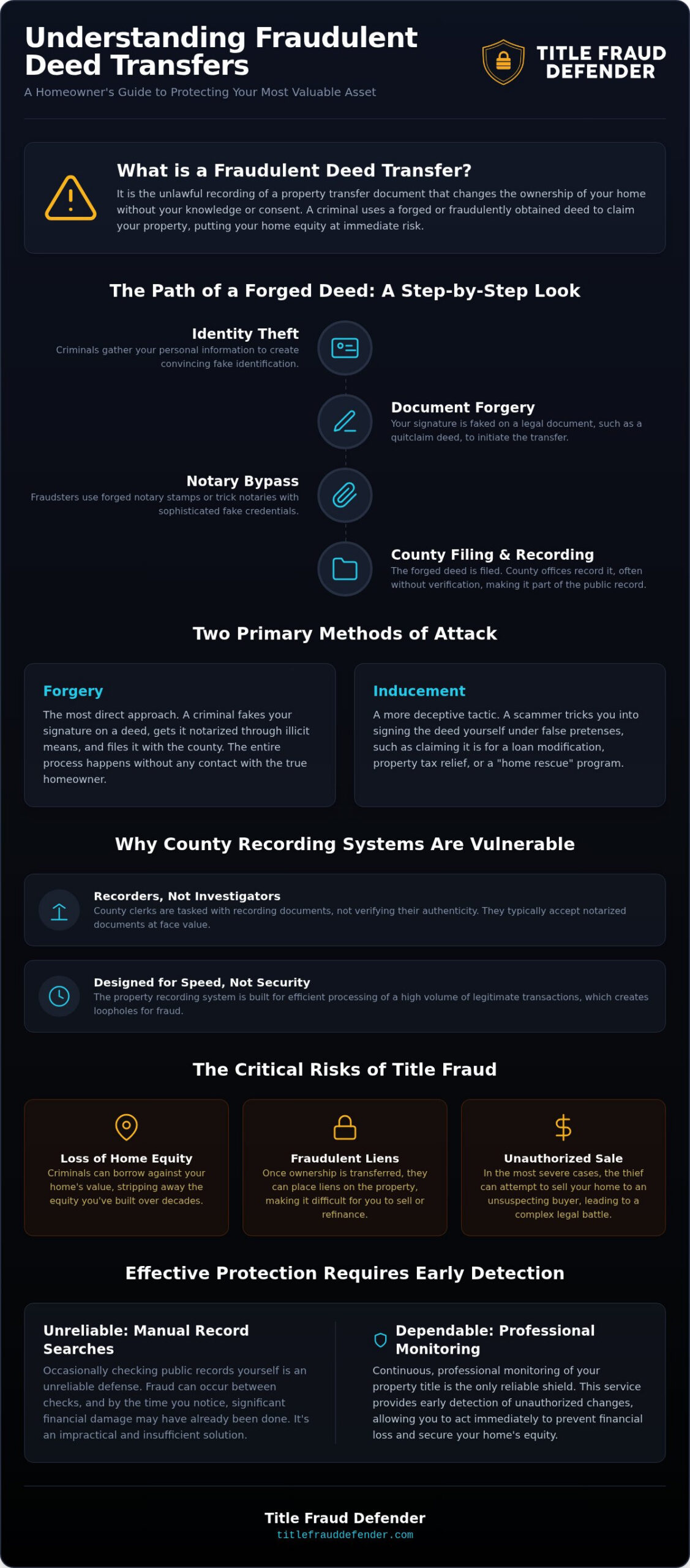
To protect your home, you must first understand the mechanics of property ownership. A deed is essentially the legal receipt for your home. It is the official document that transfers ownership from one person to another. When this process is compromised, it results in a fraudulent conveyance of your property rights. So, what is a fraudulent deed transfer? It is the unlawful recording of a property transfer document that changes the ownership of your home without your knowledge or consent.
Legitimate property transfers happen during a home sale or when you move assets into a trust. These involve verified signatures and notarized documents. A fraudulent transfer bypasses these safeguards. Once a criminal records a forged deed at the county clerk’s office, the public record shifts. In the eyes of the government and potential lenders, the criminal now appears to be the rightful owner. This creates a dangerous situation where your equity is no longer under your control.
The Difference Between Forgery and Inducement
Criminals typically use two methods to seize a title. Forgery is the most direct approach. In this scenario, a fraudster fakes your signature on a legal document, such as a quitclaim deed, and finds a way to get it notarized. They then file it with the county. Inducement is more deceptive. This occurs when a scammer tricks a homeowner into signing a deed under false pretenses. They might claim you are signing for a loan modification or a tax break. Both methods lead to the same outcome: your home equity is siphoned away through a fraudulent deed transfer.
Why Your Deed Is Your Most Critical Document
Your deed is the ultimate proof of your home equity. It is the foundation of your financial legacy. If a criminal successfully records a new deed in their name, they gain the power to exploit your property. They can take out massive loans against your home or even attempt to sell it to an unsuspecting buyer. This document is a prime target for identity thieves because it represents a high-value asset that is often poorly monitored. For senior homeowners, the stakes are particularly high, as their home often represents their largest life savings. Title Fraud Defender emphasizes that because the county system is built for speed rather than verification, your deed remains vulnerable unless it is actively guarded.
Common Methods Scammers Use to Transfer Titles
Criminals don’t need to break into your house to steal it. They only need to break into your property’s legal record. This process usually begins with identity theft. A fraudster gathers your personal information to create convincing, fake identification. With a forged state ID or driver’s license in hand, they can impersonate you in front of a notary. They often target properties with significant equity or homes that appear vacant, such as rental units or vacation properties. By faking your signature on a quitclaim or warranty deed, they initiate the transfer of your most valuable asset.
Another sophisticated tactic involves the abuse of Power of Attorney documents. A scammer might forge a document that grants them the legal authority to act on your behalf. They then use this “authority” to transfer the property to an accomplice or a shell company. This highlights the complexity of what is a fraudulent deed transfer, as the paperwork often looks perfectly legal to an outside observer. If you want to verify your property’s current status, you can start with a professional title check to ensure no unauthorized changes have occurred.
The Role of the Notary in Fraudulent Transfers
Notaries are meant to be the gatekeepers of legal documents. Criminals, however, have found ways to bypass this verification. Some use forged notary stamps to make a document appear legitimate. Others target mobile notary services, providing them with sophisticated fake credentials that are difficult to detect during a quick meeting. Once a document bears a notary seal, county clerks typically accept it at face value. The clerk’s office rarely performs independent identity verification, which allows the forged deed to enter the public record without a second look.
Exploiting Vulnerable Homeowners and Seniors
Scammers frequently use emotional manipulation to achieve their goals. Educational resources from the Ohio State University Farm Office explain that deed fraud often involves deceptive legal maneuvers that trick owners into signing away their rights. For senior homeowners, this often happens under the guise of “home rescue” or refinancing assistance. A fraudster might claim they are helping you lower your property taxes or modify a mortgage. They use high-pressure tactics to secure a signature on a deed, often leaving the homeowner unaware that they have signed over their home until the equity has been siphoned away.
Why County Recording Systems Are Vulnerable to Fraud
You might assume that a government office would verify the legitimacy of every document it handles. Unfortunately, the property recording system in the United States was never designed to be an investigative body. When homeowners ask what is a fraudulent deed transfer, they are often shocked to learn that the vulnerability is built into the system itself. County clerks operate under specific legal mandates that prioritize the speed of real estate transactions over the verification of the parties involved. This focus on efficiency creates a significant opening for criminals to exploit.
The Administrative Nature of County Records
County clerks are administrative recorders, not detectives. Their primary duty is to ensure that documents meet the standard formatting rules of the county. This is often referred to as the “face value” rule. If a deed has the correct margins, font size, and bears a notary’s seal, the clerk is generally required by law to accept and record it. They don’t have the authority or the resources to call you and ask if you actually intended to sell your home. The legal burden of accuracy rests entirely on the person submitting the document. This administrative focus ensures that legitimate home sales happen quickly, but it also means that a forged deed can enter the public record just as easily as a real one.
The Detection Gap Problem
The most dangerous aspect of deed fraud is the detection gap. This is the period between the moment a criminal files a fraudulent document and the moment you discover it. Because there is no national database to cross-reference property ownership in real time, a change in your title can go unnoticed for months. Criminals rely on this silence. They use this gap to take out home equity lines of credit or sell the property to an unsuspecting buyer who believes the public record is accurate. By the time you receive a tax bill in someone else’s name or a notice of default for a loan you never signed for, the criminal has likely vanished with the cash. Title Fraud Defender provides the constant oversight necessary to close this gap. While you cannot stop a criminal from attempting to file a document, early detection ensures you can act before your equity is siphoned away. If you are concerned about your current status, you can call a specialist at 866-326-8650 to discuss your property’s security.
The Serious Consequences of an Unauthorized Deed Transfer
Discovering an unauthorized change to your property record is a life-altering event. While the initial crime happens in a quiet office, the consequences are loud and destructive. You lose immediate control over your home equity. Your property rights vanish. Since these cases often involve serious felony charges in states like Michigan, you can discover Law Office of Kevin Bessant & Associates to understand how such legal matters are handled. This is the devastating reality of what is a fraudulent deed transfer. The criminal now holds the legal receipt for your home, giving them the power to exploit your life’s work for their own gain. Beyond the financial theft, families often face the terrifying prospect of eviction from a home they rightfully own.
Thieves rarely intend to live in the homes they steal. Instead, they use your equity as an ATM. By posing as the owner, a criminal can take out a home equity line of credit (HELOC) or a secondary mortgage. They vanish with the cash, leaving the debt tied to your address. When the thief inevitably stops making payments, the bank begins foreclosure proceedings against the property. You are then placed in the difficult position of proving to a lender that you didn’t authorize the debt. This process can destroy your credit score and drain your remaining savings before you even set foot in a courtroom.
The “Cloud on Title” and Selling Obstacles
Even if a thief doesn’t take out a loan, their name on your deed creates a cloud on title. This term describes an unresolved claim or encumbrance that makes your property legally unmarketable. You cannot sell your home. You cannot refinance your existing mortgage. You cannot even pass the property to your heirs as part of your legacy. Clearing this record requires what lawyers call a “quiet title” action. This is a complex legal proceeding where a judge must formally declare the fraudulent document void. It often takes months or even years of litigation to resolve. For senior homeowners, the emotional toll of fighting for your own home can be overwhelming. Title Fraud Defender emphasizes that early detection is the only way to avoid this legal nightmare.
How to Detect and Prevent Deed Fraud Effectively
Waiting for the legal system to catch up with a criminal is a losing strategy. Many homeowners believe that checking their property records once or twice a year is enough to stay safe. However, manual checks are fundamentally insufficient for modern threats. A criminal can record a forged deed, secure a loan, and vanish in less than thirty days. If you only check your status occasionally, you are leaving a massive window of opportunity for fraudsters. Understanding what is a fraudulent deed transfer means recognizing that speed is the only defense that matters.
Professional oversight is the current standard for property protection. Title Fraud Defender provides a constant, digital shield that monitors your property records every hour of every day. Instead of relying on a slow, administrative system to notify you of a change, you receive instant alerts the moment any document is recorded against your title. This rapid response allows you to stop a fraudulent loan or sale before the financial damage becomes permanent. By implementing professional monitoring, you gain a clear understanding of what is a fraudulent deed transfer and how to stop it before it affects your equity.
The Power of 24/7 Title Monitoring
Title Fraud Defender acts as a digital sentry for your home equity. The system scans county records across the nation to ensure your name remains the only one on your deed. Think of it as an alarm system for your home’s legal identity. While county clerks might wait weeks to mail a paper notice, an electronic monitoring service bridges that gap instantly. This unwavering oversight provides a level of security that a homeowner simply cannot achieve on their own. Just as individuals protect their homes, businesses can safeguard their interests by using Trump Tariff Relief to navigate complex trade regulations and recover funds. You can rest easy knowing that your legacy is being guarded by experts who understand the hidden risks of the recording system.
You can begin securing your property right now without any technical barriers. Follow these simple steps to fortify your home equity:
- Start with a free title check. Use Title Fraud Defender to verify your current ownership status and ensure no unauthorized liens have been filed.
- Verify your tax billing address. Ensure your local tax office has your current mailing address on file. Scammers often change this address first to hide their activity.
- Consult with a specialist. If you have questions about your property’s security, call a Title Fraud Defender specialist at 866-326-8650 for authoritative guidance.
Taking proactive steps today ensures that a fraudulent deed transfer never has the chance to destroy your financial future. As senior homeowners, you have worked too hard for your home to leave it vulnerable to an invisible criminal. Secure your title and protect your family’s future with the help of Title Fraud Defender.
Secure Your Property Legacy
Your home represents decades of hard work and the legacy you intend to leave for your family. Understanding what is a fraudulent deed transfer allows you to move from a place of uncertainty to one of total control. You now recognize that while county systems prioritize recording speed over verification, the resulting financial damage is entirely preventable through early detection. Professional oversight isn’t a luxury. It’s an essential shield for your property rights.
Title Fraud Defender provides the constant vigilance your home requires. You gain the advantage of 24/7 monitoring and expert guidance from property security specialists. Instead of worrying about invisible threats, you receive simple, non-technical alerts delivered directly to your phone or email. This proactive oversight ensures that your title remains in your name and your equity stays protected. You deserve the peace of mind that comes from knowing your most valuable asset is secure.
Take the final step in fortifying your home. You have the knowledge and the tools to protect your future. Rest easy knowing that a dedicated sentry is watching over your property every hour of the day.
Frequently Asked Questions
Is a fraudulent deed transfer the same as home title theft?
Yes, these terms are often used interchangeably to describe the same criminal act. A fraudulent deed transfer is the specific legal mechanism used in home title theft. It occurs when a criminal records a forged document at the county clerk’s office to change the ownership records of your home. Title Fraud Defender specializes in detecting these unauthorized changes before a fraudster has the chance to exploit your property’s equity for their own financial gain.
Can someone really steal my house without me knowing it?
Yes, a criminal can seize your property rights without ever stepping foot on your land. Because county offices record documents without verifying the identity of the person filing them, a forged deed can be entered into the public record silently. You might not discover the change until you receive a tax bill in another name or a foreclosure notice for a loan you never authorized. Understanding what is a fraudulent deed transfer is the first step in recognizing this invisible threat.
Does title insurance protect me from a fraudulent deed transfer?
Standard title insurance typically protects you only from issues that existed before you purchased your property. It does not provide active oversight for new, fraudulent documents filed years after your home purchase. Title Fraud Defender provides the 24/7 title monitoring that insurance lacks. While your original policy covers past errors, ongoing monitoring acts as a digital sentry to protect your home equity from future criminal activity and unauthorized recordings.
How do I know if my property deed has been transferred fraudulently?
You can identify a fraudulent transfer by looking for unauthorized changes in your county’s property records. Common warning signs include receiving a notice for a new lien, a tax bill addressed to an unfamiliar person, or a sudden change in your mailing address on file with the county. Title Fraud Defender provides instant alerts for these changes so you don’t have to rely on manual checks of county records to ensure your title remains in your name.
What should I do if I find a suspicious document recorded against my title?
You should take immediate action by contacting local law enforcement and reporting the incident to the county recorder’s office. You will likely need to begin a legal proceeding known as a quiet title action to void the fraudulent document. Title Fraud Defender provides expert guidance to help you navigate this complex situation. You can call a specialist at 866-326-8650 to receive authoritative advice on the necessary steps to secure your property and restore your ownership rights.
Why do county clerks allow fraudulent deeds to be filed?
County clerks are administrative recorders rather than investigators. Their primary legal duty is to ensure that documents meet basic formatting requirements, such as margin size and the presence of a notary seal. They do not have the authority or resources to verify the authenticity of every signature. This administrative focus is why understanding what is a fraudulent deed transfer is so critical, as the system prioritizes recording speed over the verification of the parties involved.
How often should I check my property title for unauthorized changes?
Manual checks are often insufficient because criminals can record a deed and secure a fraudulent loan in less than thirty days. Checking your title once or twice a year leaves a massive window of vulnerability for your equity. Title Fraud Defender recommends continuous 24/7 title monitoring as the only reliable way to catch unauthorized changes the moment they occur. Professional oversight removes the risk of missing a critical detection window and ensures your home remains secure.
Can Title Fraud Defender stop a criminal from filing a forged deed?
No service can physically prevent a criminal from submitting a forged document to a county clerk. However, Title Fraud Defender ensures that you are notified immediately when a filing occurs. While the county system cannot stop the initial filing due to a lack of identity verification, early detection allows you to take action before the criminal can sell the home or take out a loan. This rapid response is the only dependable way to protect your financial security.