

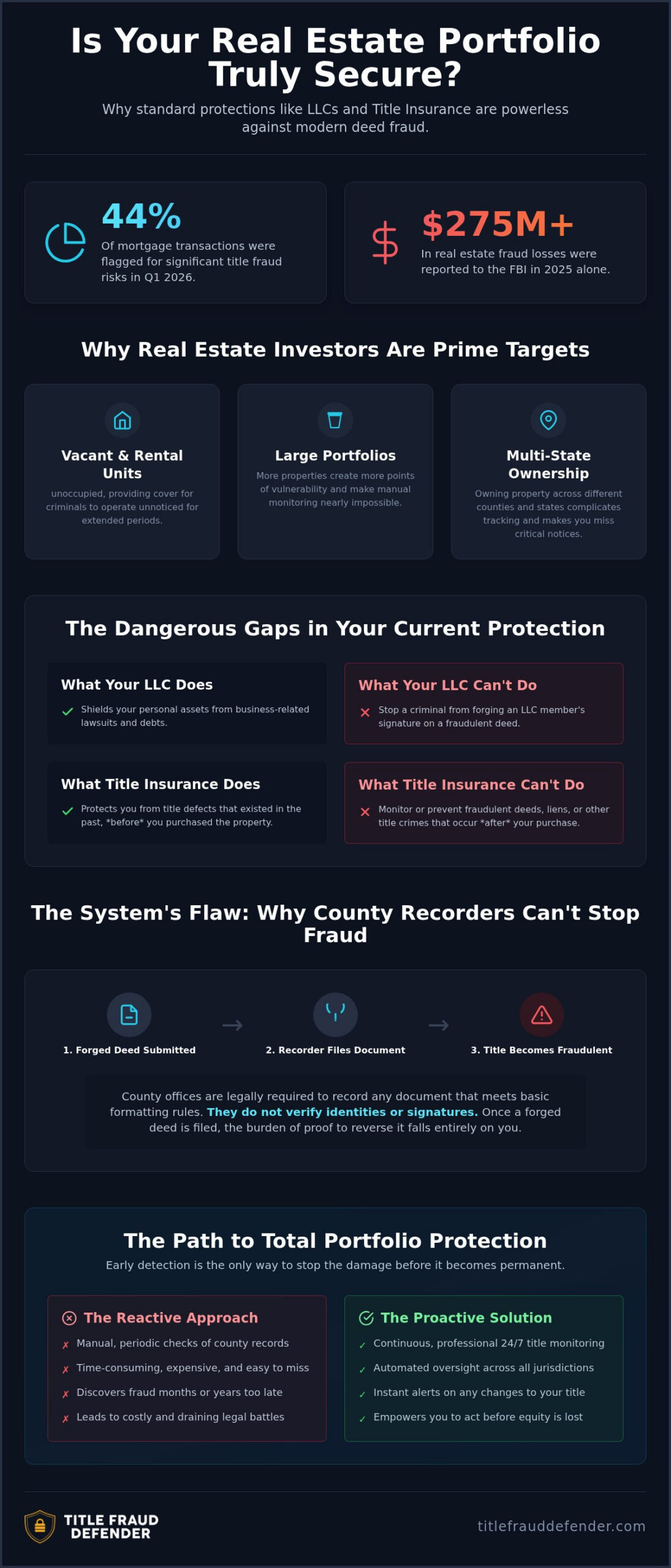
Your LLC protects your personal assets from a lawsuit, but it is completely powerless against a criminal who wants to steal your property’s deed. Many investors believe that once a title policy is issued, their equity is safe forever. This is a dangerous assumption. According to the FBI, real estate fraud losses surpassed $275 million in 2025. Even more concerning, nearly 44% of mortgage transactions in the first quarter of 2026 were flagged for significant title fraud risks.
You have spent years building a multi property portfolio across different jurisdictions. Managing these assets is already a full time job, and the thought of manually checking county records for every property is exhausting and expensive. Title Fraud Defender understands this burden. This article explains how to achieve comprehensive real estate investor portfolio protection by shielding your deeds from unauthorized changes and hidden liens that standard insurance often misses. You will discover a streamlined path to total oversight that removes the need for manual audits while keeping your hard earned equity under constant, professional watch.
Key Takeaways
- Identify why vacant properties and rental units within your portfolio are high-value targets for sophisticated deed fraud schemes.
- Learn why standard title insurance and LLCs fail to stop fraudulent filings and why a proactive approach is necessary for future security.
- Discover how professional real estate investor portfolio protection shields your equity by detecting unauthorized liens and transfers across multiple jurisdictions.
- Simplify your asset management by moving away from time-consuming manual title audits toward a more reliable, automated oversight system.
- Understand the importance of a multi-layered defense that combines existing legal protections with the constant vigilance of Title Fraud Defender.
The Vulnerability of Real Estate Portfolios to Title Fraud
Your property portfolio represents years of disciplined growth. For a fraudster, it represents a massive payday. Real estate investors are prime targets for deed fraud because they often hold significant equity in properties they do not occupy. Rental units and secondary homes provide the perfect cover for criminals to operate. If you aren’t living in the property, you might not notice suspicious activity until your equity is gone. Early detection is the only way to stop the damage before it becomes permanent.
The human stakes are high. This loss impacts your hard earned equity and involves the massive legal costs of reclaiming a stolen title. Many investors assume their title insurance policy provides total security. In reality, these policies usually protect against past defects, not future fraud attempts. True real estate investor portfolio protection requires a strategy that monitors your deeds every hour of every day. Without constant vigilance, a single forged signature can compromise an asset you have spent decades building.
Why Investors are Targeted More Often
Criminals look for the path of least resistance. A multi property portfolio offers multiple points of entry. If you own properties in different states, you are at a higher risk. You may not receive mailed notifications from a local county recorder, and you can’t physically check on every door every week. Tenant occupied homes are particularly vulnerable. Fraudsters can impersonate the owner to sell or refinance the property, often convincing buyers or lenders that they are the legitimate title holders. Even if you have placed your assets in an LLC, a criminal can forge the signature of an LLC member just as easily as they can forge your personal name. Asset protection structures shield you from lawsuits, but they don’t lock your deed. Understanding how to protect rental property title assets from deed fraud is an essential step every landlord must take in 2026.
The Limitations of the County Recorder System
It is a common misconception that the government verifies the documents filed in the public record. In reality, most county offices are legally required to record any document that appears to be in the proper form and is accompanied by the correct fee. They are not investigative bodies. They don’t call you to verify a sale, and they rarely perform rigorous identity checks at the point of recording. Once a forged deed is filed, the burden of proof falls entirely on you. You must hire attorneys and go to court to void the fraudulent conveyance. This process is emotionally draining, especially for senior homeowners who rely on their property equity for retirement. Professional monitoring is the only way to ensure you are alerted the moment a document is filed against your name.
LLCs and Title Insurance: Why They Are Not Enough
You likely believe your investments are locked down. You have the LLC. You have the title insurance. You have the property coverage. These are essential tools, but they are not a vault. They leave the back door wide open to title thieves. Property insurance is for fire and wind. It replaces your roof. It does not replace your deed. If a criminal steals your title, your property insurance provider will not help you. To Protect Your Investments, you must look beyond traditional liability structures.
A “cloud on title” is any document, claim, or unreleased lien that makes the ownership of a property uncertain. A fraudulent deed creates a massive cloud. It stops you from selling. It stops you from refinancing. It freezes your capital instantly. When a fraudster files a forged document, they are creating a legal mess that can take years to clean up. You need a way to stop this cloud from forming in the first place.
The Title Insurance Misconception
Most investors pay for an owner’s title insurance policy at closing and never think about it again. This is a mistake. Title insurance is a snapshot of the past. It protects you against errors or claims that happened before you bought the property. It does not monitor what happens after you own it. If a fraudster files a forged deed tomorrow, your original policy won’t stop them. Resolving an insurance claim can take months or even years of litigation. During that time, your equity is trapped and your project is stalled. Effective real estate investor portfolio protection requires a forward-looking solution that watches for new filings, not just a historical record of old ones.
Legal Structures vs. Fraud Prevention
LLCs are excellent for shielding your personal bank account from a slip and fall lawsuit. They are not a shield against forgery. A criminal does not need to break into your LLC to steal your property. They simply forge the signature of an LLC manager or member on a new deed. The county recorder sees a document that looks valid and files it. Your asset protection strategy is incomplete without an active monitoring layer that watches for these specific threats. You can check bulk property protection options to see how to add this layer to your existing portfolio. Achieving true real estate investor portfolio protection means knowing the moment a signature is forged, not finding out months later when you try to sell.
Evaluating Real Estate Investor Portfolio Protection Strategies
Choosing the right strategy for real estate investor portfolio protection is a balance between time and security. You cannot rely on luck. You must combat property title fraud with a system that matches the speed of modern criminals. Many investors try to handle this themselves through manual audits. Others fall for “title lock” services that often function more as a marketing term than a security protocol. Professional monitoring provides the real time alerts you need to stay ahead of unauthorized filings. It replaces guesswork with certainty.
The Cost of Manual Oversight
If you own 10 or more properties, you know the administrative burden. Searching county websites is a grueling chore. Every jurisdiction has a different interface and recording speed. Some counties update records daily while others take weeks to reflect new filings. If you miss a single alert, a fraudster could take out a fraudulent mortgage against your equity before you even realize a document was filed. Manual checking is reactive. It relies on you having the time and focus to catch a needle in a haystack. For a growing portfolio, this approach is unsustainable. It creates a false sense of security while leaving your assets exposed to human error. Financial institutions face this same challenge, which is why collateral protection for mortgage lenders has become a critical component of modern lending security strategies.
Lien Reports and Hidden Encumbrances
How to Build a Multi-Layered Defense for Your Investments
Securing your assets requires more than a single legal document. You must build a defensive wall with multiple layers. Comprehensive real estate investor portfolio protection combines your existing LLCs and insurance with a proactive monitoring system. Whether you are managing local rentals or institutional-grade assets through Cornerstone Real Estate Investment Services, this strategy ensures that if one layer is bypassed, another is there to catch the threat. You need a protocol that moves as fast as the criminals targeting your equity. Reliance on a single method of protection is a gamble you cannot afford to take with your life’s work.
Step 1: Conduct a Baseline Title Audit
Every defense begins with a clear understanding of the current landscape. You cannot protect a portfolio if the foundation is already compromised. Title Fraud Defender recommends starting with a free title check for every property you own. This baseline audit identifies existing clouds on title or unknown liens that may have been filed months ago. Verify that every property in your portfolio is accounted for and that the recorded ownership matches your records exactly. This step clears the path for ongoing monitoring by ensuring you aren’t already fighting a battle you didn’t know existed.
Step 2: Automate the Monitoring Process
Manual checks are a relic of the past. They are too slow for the modern fraudster. You must transition to 24/7 automated title monitoring to maintain total oversight. Automation is the cornerstone of modern real estate investor portfolio protection. This system sets up immediate alerts for new deeds, liens, or mortgage filings against your assets. Automation removes the risk of human error and ensures you never miss a critical update. You can explore how automation scales for your entire portfolio by reading the guide on Bulk Property Protection. This layer of defense acts as a digital sentry that never sleeps.
Step 3: Establish a Fraud Response Plan
Prepare for the worst before it happens. An alert is only useful if you know exactly how to respond. Establish a fraud response plan that identifies which experts to contact the moment an unauthorized filing is detected. Keep physical or digital copies of all original deeds in a secure, separate location. This documentation is vital for proving your legitimate ownership to county officials or law enforcement. Remember that the goal of early detection is to stop a fraudulent sale or refinance before the closing occurs. If a fraudster successfully closes on a fake sale, the financial and emotional toll on you increases exponentially. Early intervention is the only dependable way to keep your equity intact.
Professional Bulk Property Protection with Title Fraud Defender
Standard security services often fail to meet the needs of serious investors. They are typically designed for one house and one owner. Real estate investor portfolio protection requires a more robust solution that handles the complexity of multiple assets across various jurisdictions. Title Fraud Defender fills this gap by offering specialized monitoring that scales with your growth. This service maintains 24/7 vigilance over every deed in your strategy, ensuring that a single unauthorized filing does not derail your entire operation.
Bulk plans are engineered to be cost effective for investors with multiple assets. Instead of managing dozens of individual accounts, you can consolidate your security under one protective umbrella. This approach provides a high level of oversight without the administrative overhead that usually comes with portfolio management. If an alert triggers, you are not left to solve the problem alone. Title Fraud Defender provides expert guidance to help you interpret the situation and navigate the resolution process. This proactive support ensures that you stay in control of your equity at all times.
Comprehensive Oversight for Every Asset
Managing properties across different counties or states creates a fragmented view of your assets. It is easy for a fraudulent lien or unauthorized deed change to go unnoticed when you are focused on property management and acquisitions. Title Fraud Defender consolidates this oversight into a single, intuitive dashboard. You can monitor titles and liens across multiple jurisdictions simultaneously without ever visiting a county recorder’s office. The moment an unauthorized change occurs, the system triggers an instant alert. This digital sentry provides the unwavering presence needed to protect your home equity from sophisticated criminals who rely on your lack of physical presence at every property. The same vulnerabilities that threaten individual investors also affect lending institutions, making collateral protection for mortgage lenders an equally essential safeguard for any party with a financial interest in a property’s title.
Getting Started with Your Portfolio Defense
Securing a large portfolio does not have to be a technical or administrative burden. You can begin by performing a free title check on your most valuable assets today. This initial step ensures your records are currently clean and provides a baseline for future monitoring. If you have questions about how to implement bulk property protection for your specific holdings, call a specialist at 866-326-8650. They can discuss your specific portfolio needs and help you set up a monitoring schedule that covers every deed you own. By moving away from manual checks and embracing professional oversight, you ensure your investment legacy remains protected from the invisible threat of deed fraud. Take action now to place your assets under the watch of a dedicated guardian.
Shield Your Equity for the Long Term
Protecting your multiple property investments requires a shift from reactive insurance to proactive vigilance. You have learned that legal structures like LLCs and standard title insurance policies are snapshots of the past. They don’t alert you to future fraudulent filings. Achieving true real estate investor portfolio protection requires a multi layered defense that monitors every deed and lien in your portfolio around the clock. By moving away from manual audits, you eliminate the risk of human error and keep your capital liquid.
Title Fraud Defender provides the specialized bulk plans and expert guidance necessary to resolve any issues if a threat is detected. This 24/7 monitoring acts as a digital sentry, ensuring that your investment strategy is never derailed by a forged signature or a hidden lien. You have worked hard to build your portfolio. Now is the time to ensure it is defended by a system that never sleeps.
Frequently Asked Questions
What is real estate investor portfolio protection?
Real estate investor portfolio protection is a specialized security strategy designed to monitor multiple properties for unauthorized deed changes or fraudulent liens. While individual home protection focuses on a single residence, portfolio protection offers a centralized dashboard to track assets across different jurisdictions. This method ensures that investors with several properties don’t have to visit multiple county websites. It provides a digital shield that alerts you the moment any document is filed against your holdings.
Can deed fraud happen if my property is in an LLC?
Yes, holding a property in an LLC does not prevent a criminal from filing a forged deed. Fraudsters often impersonate LLC managers or members to sign documents that transfer ownership to a third party. While an LLC provides liability protection against lawsuits, it does not verify the authenticity of signatures at the county recorder’s office. You must have an active monitoring layer to detect when someone is using your business name to commit title theft. For comprehensive brand protection beyond the county records, using a platform like EnforceShield ensures your business identity and intellectual property are also shielded from online infringement.
Is title monitoring different from title insurance?
Title monitoring and title insurance serve completely different purposes. Title insurance is a one time policy purchased at closing that protects against defects that occurred before you owned the property. It does not watch for future fraud. Title monitoring is a continuous service that watches the public record for new filings. It provides the early detection needed to stop a fraudster from selling your property or pulling equity out through a fraudulent mortgage.
How often should an investor check their property titles?
An investor should ideally have their titles monitored 24/7 rather than relying on manual checks once or twice a year. Manual audits are time consuming and leave long windows of vulnerability where a fraudster can act. If you only check your records every six months, a criminal could file a deed and sell the property before you even notice. Professional real estate investor portfolio protection eliminates these gaps by providing instant alerts for every new filing.
What happens if Title Fraud Defender detects a change on my deed?
Title Fraud Defender sends an immediate alert to your preferred contact method the moment a change is detected. Once you receive the notification, you can access your dashboard to view the specific details of the filing. Title Fraud Defender also provides expert guidance to help you understand the next steps for resolution. This might include contacting local law enforcement or a specialist to void the fraudulent document before further damage occurs.
Can I monitor commercial properties as well as residential ones?
Yes, professional monitoring services can track both commercial and residential real estate assets. Many investors hold a mix of property types, and all are susceptible to deed fraud if they have significant equity. Title Fraud Defender offers bulk property protection plans that cover diverse portfolios. This ensures that whether you own a single family rental or a small office building, your equity is protected by the same high level of vigilance.
Is it possible to stop a forged deed from being filed?
It is currently almost impossible to stop a forged deed from being filed because county recorders are generally required to record any document that appears valid. They do not have the resources to verify the identity of the person who signed the document. However, you can stop the financial damage by detecting the filing immediately. Early detection allows you to intervene before a fraudster can sell the property to an innocent buyer or disappear with loan proceeds.