

What if a stranger sold your home while you were still sleeping in it? This is the reality of deed fraud, and it happens faster than most homeowners realize. If you have discovered an unauthorized change to your property records, your home equity is under immediate attack. You likely feel a mix of intense fear and total confusion about the legal jargon involved in fixing this mess. It is natural to worry about the cost and time required to restore your ownership.
You deserve a clear path to security. This guide outlines exactly what to do if your house deed is stolen by providing a professional emergency response plan. You will learn the critical checklist of who to notify first, the process for restoring your legal name to the deed, and how to implement long-term defenses. Title Fraud Defender stands as a digital sentry in this process, offering the expert guidance and constant monitoring needed to reclaim your peace of mind. Follow these steps to secure your title and stop the threat before it is too late.
Key Takeaways
- Identify critical warning signs like unexpected mail from the county recorder to catch unauthorized deed transfers before they become a total loss.
- Follow a methodical emergency response plan on what to do if your house deed is stolen to halt equity stripping and secure your property records.
- Protect your broader financial integrity by freezing your credit files to prevent fraudsters from securing loans against your home.
- Understand the process of clearing a clouded title and restoring your legal ownership through a Quiet Title Action.
- Transition from reactive recovery to proactive vigilance by using 24/7 Title Monitoring from Title Fraud Defender to block future fraud attempts.
Confirming Your Suspicions: Signs Your House Deed Has Been Stolen
Deed theft is a calculated financial crime. It starts when a fraudster forges your signature on a transfer document. They present this document to the county recorder to move ownership into their name or a shell company. This act of understanding mortgage fraud allows them to steal your equity without you ever leaving your living room. Title Fraud Defender reports that many victims remain unaware of the theft until they receive a foreclosure notice for a loan they never authorized. Knowing what to do if your house deed is stolen begins with identifying these silent warnings before the damage becomes irreversible.
Red Flags in Your Mailbox and Public Records
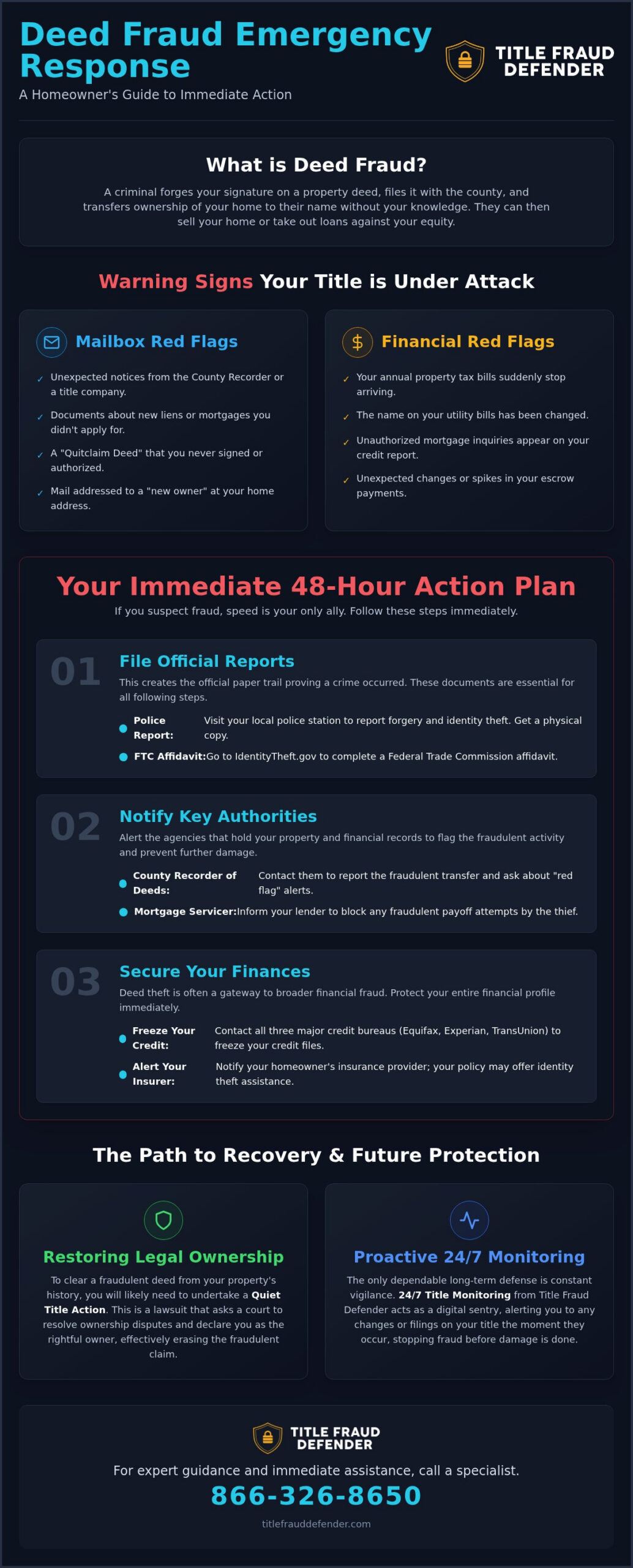
Your mailbox is often the first line of defense. Pay close attention to any correspondence from the county recorder or a title insurance company. You should never receive a “thank you” for a transaction you didn’t initiate. Look for notices regarding new liens or mortgages. These indicate someone is using your home as collateral. Watch for “Quitclaim Deeds” filed in your name. If you didn’t sign one, it is a forgery. Be especially alert if you see mail addressed to a “new owner” at your house. This is a glaring sign that the public record has already been altered. For senior homeowners, these mail indicators are often the only early warning signs available. Don’t ignore mail that looks like a mistake. Knowing what to do if your house deed is stolen requires you to treat every piece of official mail as a potential security alert.
Financial Indicators of Title Fraud
Fraudsters often redirect property tax bills to hide their tracks. If your annual tax assessment suddenly stops arriving at your address, investigate the cause immediately. A change in the name on your utility accounts is another massive red flag. Thieves do this to establish residency on paper and deceive lenders. Monitor your credit report for unauthorized inquiries from mortgage lenders. These inquiries suggest someone is shopping for a loan using your property as the prize. Review your bank statements for changes in your escrow payments. An unexpected spike or drop could mean a new lien has been attached to your title without your consent. Act with speed. Silence from the county does not mean safety. It means the system is working exactly as the fraudster intended. If you see these signs, call a specialist at 866-326-8650 for immediate assistance. Total vigilance is your only shield.
Immediate Actions: Your Emergency Response Plan
Speed is your only ally in a property emergency. If a criminal has successfully forged your signature, they are likely already moving to strip your equity or sell the home to an unsuspecting buyer. Knowing exactly what to do if your house deed is stolen is the difference between keeping your home and losing everything. You must act within the first 48 hours to freeze the situation and protect your assets. Call a specialist at 866-326-8650 for immediate expert guidance tailored to your specific threat level. While protecting yourself from title fraud is a long-term goal, your immediate focus must be on legal containment.
Filing a Police Report and FTC Affidavit
Go to your local police station immediately to file a formal report for forgery and identity theft. Obtain a physical copy of the report. This document is the foundation of your recovery. It serves as the primary evidence required by banks, recorders, and courts to prove a crime occurred. Next, visit IdentityTheft.gov to complete a Federal Trade Commission (FTC) Identity Theft Affidavit. This standardized federal form proves your victim status to financial institutions. Keep a meticulous log of case numbers and officer names. This record ensures your case stays on track during the investigation.
Notifying the County Recorder and Financial Institutions
Contact the County Recorder of Deeds to flag the fraudulent transfer. Most county systems are passive and do not verify signatures, so you must alert them manually. Ask if your county offers a “red flag” notification system for future filings. Simultaneously, notify your mortgage servicer. They must stop any fraudulent payoff attempts by the thief. Reach out to your homeowners insurance provider as well. Some policies include limited identity theft assistance that can help with the administrative costs of your recovery. Proactive notification is a crucial part of what to do if your house deed is stolen.
Taking decisive action is the only way to stop a title thief in their tracks. This response plan provides the clarity you need to move from victim to victor. To ensure your home is monitored every second of every day, you can review protection plans that offer 24/7 title and lien oversight. Title Fraud Defender acts as your digital sentry, ensuring you never have to face this crisis alone again.
Securing Your Financial Assets and Credit
Deed theft is rarely an isolated event. It is a gateway to broader financial destruction. When a criminal gains control of your property title, they often move to exploit your entire financial profile. They target your bank accounts, credit cards, and existing home equity lines of credit (HELOCs). Understanding what to do if your house deed is stolen must include a total lockdown of your financial identity. You must act to prevent the thief from turning your home’s value into their personal cash reserve. If you are a property owner, you are a target for those looking to drain assets quickly. This is not just about a piece of paper; it’s about the security of your life’s savings.
Implementing a Credit Freeze
A credit freeze is your most powerful tool against secondary identity theft. It prevents lenders from accessing your credit report to open new accounts. You must contact Equifax, Experian, and TransUnion individually to execute this. This process is free. It doesn’t lower your credit score. It doesn’t affect your current accounts. It simply creates a wall that stops fraudsters from using your stolen identity to secure new loans in your name. Do not wait for a suspicious charge to appear. Lock your files immediately. This creates a permanent barrier that only you can lift with a secure PIN or password.
Monitoring for Fraudulent Liens
Criminals frequently use stolen deeds to file fraudulent liens against the property. This tactic allows them to extort money or cloud the title further. They may file fake “mechanic’s liens” or “judgment liens” that appear legitimate to the untrained eye. Review all existing lines of credit for unauthorized drawdowns. Title Fraud Defender recommends a comprehensive lien report to uncover hidden debts attached to your home. Expert guidance from Title Fraud Defender helps you differentiate between valid obligations and criminal forgeries. For senior homeowners, this oversight is critical as they are often the primary targets for these sophisticated equity-stripping schemes. If you suspect unauthorized activity, call 866-326-8650 to speak with a specialist who can help you audit your property’s financial health. Identifying these liens early prevents them from maturing into foreclosures or complicated legal battles. Do not let a forged document become a permanent debt.
The Road to Recovery: Clearing a Clouded Title
A stolen deed leaves a “cloud” over your property title. In legal terms, this means your ownership is no longer undisputed. Even if you are currently living in the house, you cannot sell it, refinance it, or transfer it to heirs until this cloud is removed. Understanding what to do if your house deed is stolen involves moving beyond police reports and into the civil court system. You must prove to the state that the recorded document is a forgery. This process requires a specific legal mechanism called a Quiet Title Action to restore your rightful status as the owner of record. Do not wait for the fraudster to sell the home to an innocent third party. Speed is essential to prevent the situation from becoming a multi-year legal nightmare.
Understanding Quiet Title Actions
Navigating the court system alone is nearly impossible. You need a real estate attorney who specializes in property fraud. Be wary of “deed recovery” services that demand high upfront fees and promise instant results. These are often predatory scams themselves. Instead, identify attorneys who have specific experience protecting senior homeowners from sophisticated title theft schemes. Your attorney should coordinate directly with law enforcement to ensure evidence from the criminal investigation supports your civil case. While Title Fraud Defender does not provide legal representation, the expert guidance team can help you organize your records for your attorney. If you feel overwhelmed by the legal requirements, call 866-326-8650 to speak with a specialist who can help you map out your recovery strategy.
Preventing a Recurrence: Moving from Response to Monitoring
Reclaiming your home is a major victory, but it is not a permanent solution. Recovering from deed theft once does not prevent a fraudster from targeting you again. In fact, many criminals view previously compromised properties as soft targets. They assume you have let your guard down after the legal battle ends. You must understand that county recording systems are designed for public notice, not for security. These offices do not verify the identity of the person filing a document. They simply record what is presented. This systemic vulnerability remains even after you clear your title. Knowing what to do if your house deed is stolen must include a plan for long-term vigilance. You need a permanent shield to ensure your equity never becomes a target again. This focus on systemic integrity and precision is also vital in other complex fields; for example, frontrunnerhc.com specializes in helping healthcare providers optimize their data and reimbursement workflows to ensure administrative accuracy.
Many homeowners believe they can manage their own security by checking public records manually. This approach is dangerously reactive. Checking county records once a month leaves a 30-day window for a criminal to sell your home or strip its equity. A lot can happen in four weeks. By the time you see the fraudulent filing, the thief has already disappeared with the cash. Public records are also filled with technical jargon that is difficult to navigate. You might miss a subtle lien or a partial transfer tucked away in a complex filing. Title Fraud Defender removes this burden by automating the oversight process. Professional title monitoring services provide the 24/7 vigilance required to catch fraud in real time, not weeks after the fact.
Establishing a Digital Shield for Your Equity
Your path to permanent security starts with a baseline assessment. Perform a free property title check to ensure your record is currently clean and undisputed. Once you have established a clean slate, implement continuous monitoring. This digital sentry alerts you the moment any document is filed against your parcel number. It acts as an early warning system that allows you to stop fraud before it matures into a legal crisis. For a complete audit of your property vulnerabilities, visit the Title Fraud Detection Checklist. This helps you identify gaps in your defense beyond just the deed itself. If you have questions about your property’s current status, call a specialist at 866-326-8650. Total control over your home’s future requires more than just a response plan; it requires an unwavering commitment to oversight. Do not leave your primary asset to chance.
Take Control of Your Property’s Defense
Property theft is a silent emergency that demands a methodical response. You now have a professional roadmap for what to do if your house deed is stolen. From filing the police report to initiating a Quiet Title Action, these steps restore your ownership. The county recorder won’t stop a fraudster for you. Take personal responsibility for your home’s defense by moving to a state of total oversight.
Transitioning to a state of constant vigilance is the only way to prevent a second attack. Title Fraud Defender provides the essential shield you need through 24/7 proactive monitoring of property titles and liens. If a threat is detected, you gain immediate access to expert guidance to resolve the incident before your equity is stripped. Don’t leave your most valuable asset unprotected in a passive system that relies on your absence.
Take control of your property’s security and sleep soundly knowing your title is under constant watch. If you have immediate questions, call a specialist at 866-326-8650. You have the tools to reclaim your peace of mind and secure your financial legacy forever.
Frequently Asked Questions
Can I get my house back if the deed was stolen and the house was sold?
Yes, you can reclaim your home because a forged deed is legally void. A thief cannot pass valid ownership to another person, even if they sell the property to an unsuspecting buyer. However, you must initiate a Quiet Title Action to prove the forgery in court. This process invalidates the sale and restores your name to the public record. Acting quickly prevents the new buyer from further encumbering your property with debt.
How much does it cost to fix a stolen house deed?
Fixing a stolen deed involves several financial layers. You will encounter court filing fees, costs for serving legal notices, and attorney fees for civil litigation. To better prepare your budget for legal action, you can explore Legal Representation and Litigation Fees to understand what pursuing a property dispute in court entails. Every case is unique, so total costs depend on the complexity of the forgery and the number of parties involved. Expert guidance from Title Fraud Defender helps you organize your evidence efficiently. This preparation can streamline the process and potentially reduce billable hours with your real estate lawyer.
Does title insurance protect me from deed theft after I buy the house?
Standard owner’s title insurance policies generally protect against defects that occurred before your purchase date. They rarely provide coverage for post-policy forgery or deed theft that happens years after you move in. This gap in protection is why 24/7 title monitoring is a necessary secondary shield. While your insurance looks at the past, Title Fraud Defender monitors the future to detect unauthorized filings the moment they occur. Constant vigilance is the only way to stay safe.
How long do I have to report a stolen house deed?
You must report the theft immediately. There is no benefit to waiting. While state laws provide varying windows for legal action, every hour you delay gives a fraudster more time to disappear with your equity. Promptly notifying law enforcement and the county recorder is the most vital step in what to do if your house deed is stolen. Early detection is your only defense against a total financial loss and a long recovery process.
Can someone steal my house deed if I have a mortgage?
A mortgage does not provide a shield against deed theft. Criminals regularly target mortgaged properties by forging a satisfaction of mortgage document or simply transferring the title anyway. They may then use your home as collateral for a new, fraudulent loan. Your lender will not always notify you if a new deed is filed. This makes independent 24/7 monitoring the only way to ensure your equity remains secure from sophisticated title thieves.
What is the fastest way to check if my deed has been stolen?
The fastest way to verify your ownership is to run a Free Title Check through Title Fraud Defender. This provides an immediate baseline of your property’s current status. You can also search the county recorder’s online database for your parcel number to see recent filings. Digital monitoring is superior to manual checks because it alerts you to new documents instantly. This allows you to stop a fraudster before they can sell your property.
Is deed theft a felony in the United States?
Deed theft is a serious felony offense across the United States. It typically involves a combination of forgery, identity theft, and residential mortgage fraud. Law enforcement agencies take these crimes seriously because they threaten the integrity of the entire property system. Filing a formal police report is a requirement for your recovery. It triggers the criminal investigation necessary to support your civil Quiet Title Action and establishes your status as a victim in the eyes of the law.
Should I pay for a title lock service if my deed is stolen?
If a theft has already occurred, you need a response plan to restore your title. A professional monitoring service is essential during and after this process. Title Fraud Defender offers 24/7 title and lien monitoring to detect any further attempts to cloud your ownership. This digital sentry provides the constant vigilance needed to ensure that once you reclaim your home, it stays in your name forever. Oversight is your most effective tool for long-term security.